Backpacks: Every Type Explained, and How to Actually Pick the Right One
"Backpack" covers everything from a $20 school bag to a $400 one-bag travel rig with a suspension system, and choosing badly means either a sore back or a bag that doesn't fit your life. The good news: picking well comes down to two questions most people skip — what will you carry it for, and does it fit your torso. Nail those and the rest is detail.
This is the map of the whole backpack world. We'll sort the types, explain the sizing that actually matters (hint: it's not your height), cover the fit and features that separate a comfortable pack from a punishing one, and point you to the deep-dive guide for whichever kind you need.
The main types of backpacks (find yours)
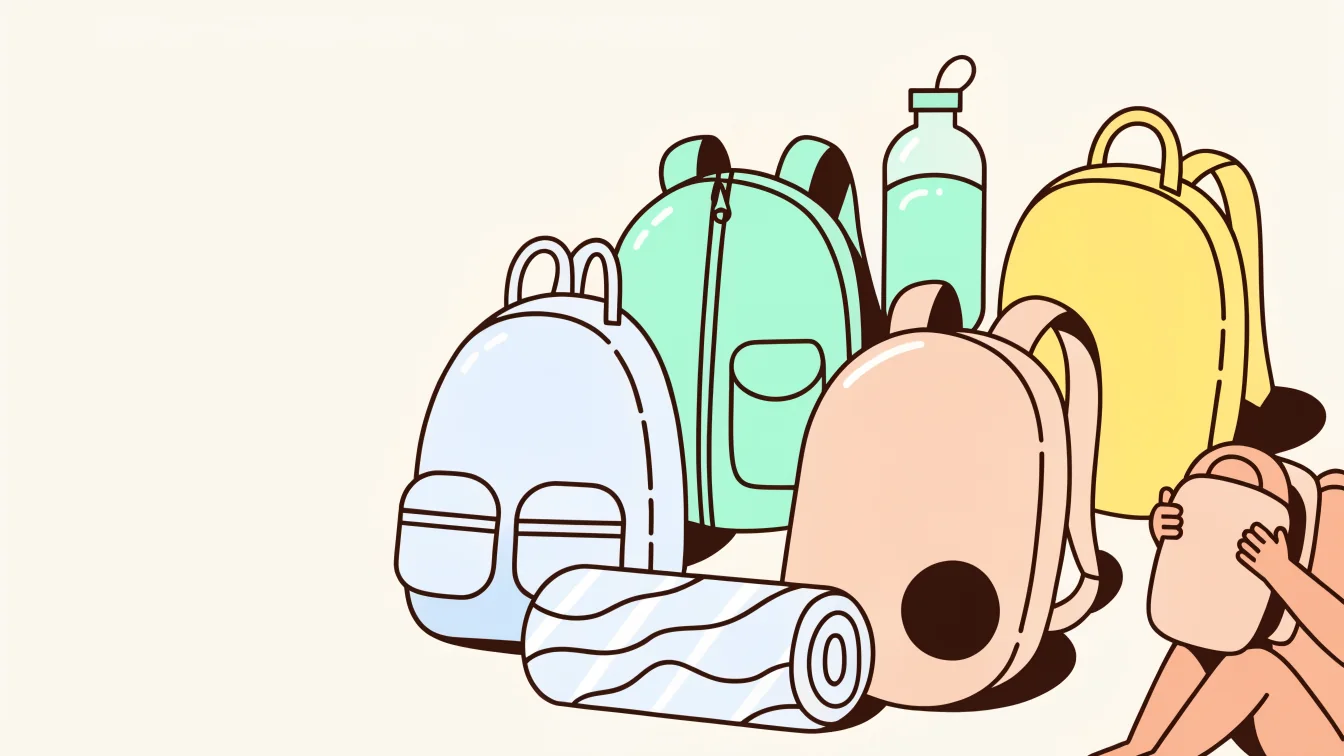
Backpacks split into a handful of families, each built for a different job. Buying a hiking pack for the office — or an office pack for a mountain — is how people end up uncomfortable.
- Everyday / commuter backpacks — the daily driver for work, errands, and getting around. Clean looks, a laptop sleeve, sensible organization. Usually 15–25L.
- Laptop / tech backpacks — a commuter pack with serious device protection: a padded, suspended laptop compartment, cable organization, sometimes RFID pockets. (Full guide: laptop bags.)
- Travel backpacks — built to replace a carry-on suitcase. They open flat like a clamshell, sit at the 35–45L carry-on size, and have stowable straps. The heart of "one-bag travel."
- Hiking / outdoor backpacks — technical packs with a frame, hip belt, and ventilated back panel to carry real weight over distance, from 10L daypacks to 70L+ expedition haulers. (Full guide: hiking backpacks.)
- School / student backpacks — durable, age-appropriate, comfortable for daily book-and-laptop loads. (Full guide: school bags.)
- Gym / sports backpacks — with a ventilated shoe compartment and a wet/dry pocket. (Full guide: gym bags.)
- Tactical / military-style backpacks — rugged Cordura or ballistic nylon, MOLLE webbing for attachments, built to abuse.
- Slings / one-strap packs — technically a cousin, worn across the body for quick access. (Full guide: sling bags.)
Find the family that matches your main use, then read on for sizing and fit — they apply across all of them.
Backpack sizes: what the liters actually mean
Backpacks are measured in liters (L) — internal volume, not dimensions. Here's what each range genuinely holds:
- 10–20L: a daypack or slim commuter — laptop, charger, lunch, a few essentials. A day out, not an overnight.
- 20–35L: the everyday workhorse — a full workday's kit, a gym change, or a light overnight. Most commuter and school packs live here.
- 35–45L: the travel sweet spot. This is the "one-bag" carry-on range — enough for several days to a couple of weeks if you pack smart, while still fitting most carry-on limits. A 40L pack is the classic one-bag size.
- 50–70L+: multi-day backpacking and expeditions. More than you need for anything urban, and often too big to carry on a plane.
The most common sizing mistake is going bigger "to be safe." A bigger pack invites overpacking, gets heavier, and may blow past carry-on limits. Size to your actual use, not your anxiety.
The sizing that actually matters: your torso, not your height
Here's the thing almost nobody knows, and it's the single most important fit fact: a backpack is sized to your torso length, not your height. Two people the same height can need different pack sizes because torso length varies independently of leg length.
Your torso length is the distance from the C7 vertebra (the bony bump at the base of your neck when you tilt your head forward) down to the point on your lower back level with the top of your hip bones. Many packs — especially hiking ones — come in multiple torso sizes or have an adjustable back panel. Get this right and the weight sits where it should; get it wrong and no amount of strap-fiddling makes the pack comfortable.
For everyday and travel packs the tolerance is more forgiving, but the principle holds: a pack that matches your torso rides better than one that doesn't, regardless of your height.
How a backpack should fit (and carry weight)

A well-fitted pack moves the load off your shoulders and onto your hips — your legs are far stronger than your shoulders. The key parts:
- Hip belt: on any pack carrying real weight, this is the workhorse. Properly fitted, it should carry roughly 80% of the load on your hips, wrapping the top of your hip bones — not sitting on your waist. Everyday packs often skip it; travel and hiking packs shouldn't.
- Shoulder straps: should wrap close with no gap at the top and no digging at the bottom. Padded, contoured straps matter more as the load grows.
- Sternum strap: the little chest clip. It stabilizes the shoulder straps and stops them sliding — small part, real difference on the move.
- Load lifters: the straps at the top of the shoulder straps (on bigger packs) that pull the load in toward your body, so it doesn't sag backward and strain you.
- Back panel: a ventilated, padded panel keeps the pack off your sweaty back and adds comfort. On hiking packs, look for airflow channels.
A quick test: loaded up and adjusted, most of the weight should feel like it's on your hips, the pack shouldn't sway when you walk, and nothing should dig in. If it does, it's the wrong size or badly adjusted — not something you should "get used to."
Panel-load vs. top-load: how it opens matters
- Panel-loading (clamshell) packs unzip fully and open flat like a suitcase, so you can see and reach everything. This is what makes a travel backpack work — you pack it like luggage, not a bottomless pit.
- Top-loading packs open at the top and you cinch them closed, the traditional hiking design. Lighter and often more weather-resistant, but you dig for anything at the bottom.
For travel and everyday use, clamshell wins on convenience. For hiking and the outdoors, top-load has its place. Match the opening to how you'll live out of the bag.
Features that matter (and how much to spend)
- Laptop compartment: padded and suspended (not resting on the bottom, where a drop lands right on your laptop). Non-negotiable for a work or travel pack.
- Organization vs. one big space: more pockets help commuters and tech carriers; one big compartment suits travelers who use packing cubes. Know which you are.
- Water bottle pockets, key clips, quick-access top pockets: small conveniences that add up daily.
- Material and durability: ballistic nylon and Cordura for hard use, lighter nylon/polyester for everyday (see our materials guide). Check the zippers and strap stitching — that's where packs fail.
- Water resistance: most packs are water-resistant, not waterproof. A true dry environment needs sealed seams and a roll-top or a rain cover.
On budget: a genuinely good everyday backpack doesn't require a splurge, but the jump from "cheap" to "buy-it-for-life" usually shows up in the straps, back panel, and zippers — the parts that touch your body and fail first. Spend there.
How to choose, in one paragraph
Start with use (commute, travel, hike, school, gym), which sets the type. Pick the capacity in liters for how much you actually carry — smaller than instinct says. Match the torso size to your body, especially for anything you'll wear loaded for hours. Check the fit and suspension (hip belt, straps, back panel) and the opening style (clamshell for travel, top-load for trail). Then sweat the durability details — zippers, strap stitching, material. Do that and you'll skip the pile of almost-right backpacks most people accumulate.
Frequently asked questions
What does 40L mean for a backpack?
Forty liters is the pack's internal capacity — the volume it holds — not its dimensions or weight. It's the classic "one-bag travel" size: big enough for several days (or longer, packed well) while usually still fitting carry-on limits. If you're choosing between one-bag travel sizes, 40L is the popular sweet spot; 30–35L suits lighter packers, 45L the edge of carry-on.
Should I get a 30L or a 40L backpack?
Go 30–35L if you pack light, travel a few days at a time, or want an everyday pack that also handles the odd overnight. Go 40–45L if you're a dedicated one-bag traveler packing for longer trips or carrying bulkier gear. Bigger isn't safer — a 40L invites overpacking and edges closer to carry-on size limits, so size to how you actually pack.
How do I know what size backpack to get?
Two numbers: capacity and torso length. Pick the liters for your use (10–20L daily, 20–35L everyday/overnight, 35–45L travel, 50L+ backpacking). Then match the pack's torso size to your body — measure from the C7 bump at the base of your neck to the level of your hip bones — because a backpack fits your torso, not your height. Two people the same height can need different sizes.
What's the 20% rule for backpacking?
It's a common guideline that a loaded backpack should weigh no more than about 20% of your body weight — so a 150-pound hiker aims to keep the pack under roughly 30 pounds. It's a rule of thumb, not a law; fitness, trip length, and experience shift it. The point is to keep the load manageable so the weight sits comfortably on your hips instead of wrecking your back.
What are backpacks also called?
Depending on where you are and the style, you'll hear rucksack, knapsack, daypack, bookbag, or haversack. "Rucksack" is common in the UK and for military-style packs; "daypack" means a smaller pack for day use; "bookbag" is the everyday school term in parts of the US. They all describe the same basic thing — a bag worn on your back with two shoulder straps.
What kind of backpacks does the military use?
Military and tactical packs are built for abuse: tough Cordura or ballistic nylon, reinforced stitching, and MOLLE webbing — the grid of straps that lets you attach pouches and gear modularly. Specific issued models vary by unit and change over time, but the common thread is rugged materials, modular attachment, and a focus on durability over looks. Civilian "tactical" backpacks borrow the same features.
Is a 17-inch backpack big?
For a backpack, 17 inches usually refers to the largest laptop it fits, not the bag's overall size — a "17-inch laptop backpack" holds up to a 17" laptop, which is on the larger end since most laptops are 13–16". As an overall bag it's a normal full-size backpack. If you're checking whether it works as an everyday or travel pack, look at the liters and the laptop-sleeve dimensions rather than a single inch figure.
Guides in this section
9 guides sit under this page.
Roundups
Best backpacks for men
Best backpacks for women
Best budget backpacks

Best everyday backpacks

Best leather backpacks