Golf bags: stand, cart, tour and travel bags
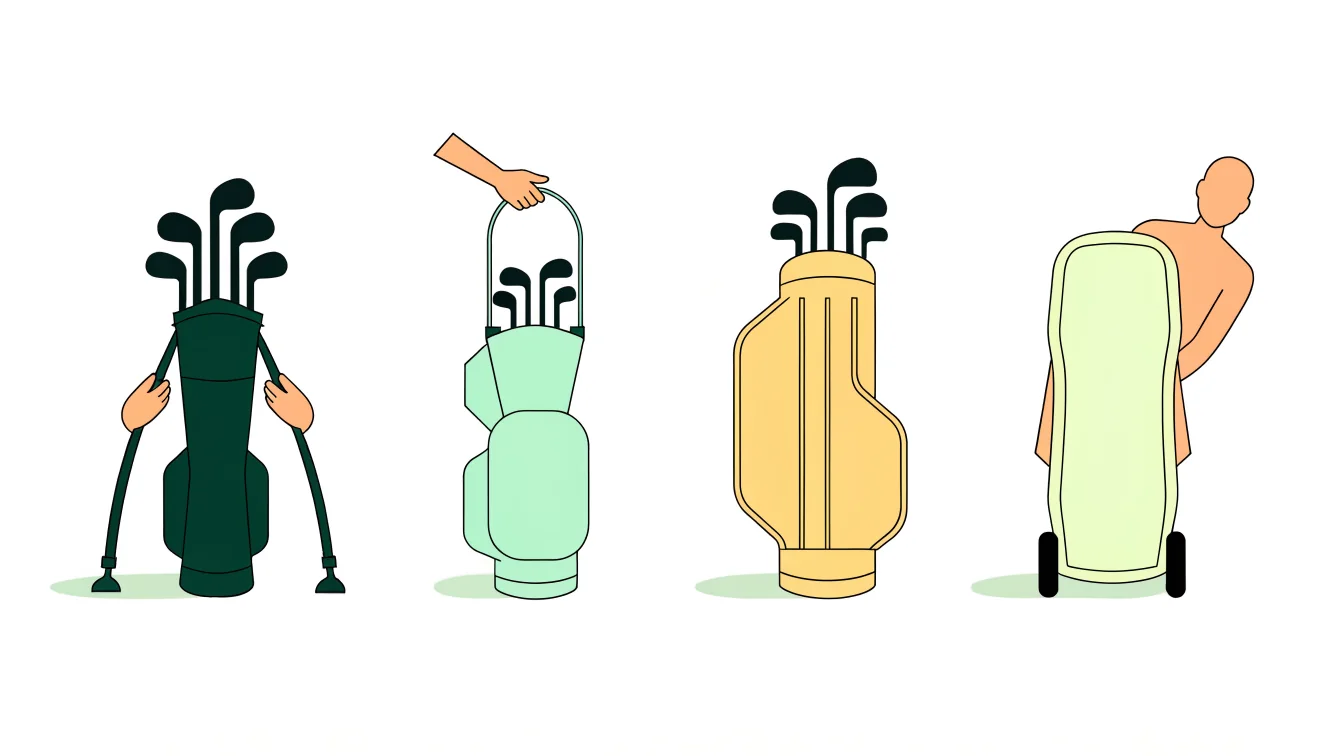
Choosing among golf bags comes down to how you reach the course and how you move around it. Walkers usually benefit from a lighter stand bag. Frequent cart users should prioritize stable bases and accessible pockets. Flying golfers need a protective travel cover as well.
Golf bag types at a glance
Many golf bags look similar in product photographs, but the differences become clear when you walk a hilly course or try to put the bag on a cart. Weight, base shape, straps and pocket opening direction determine everyday usefulness.
| Bag type | Designed for | Carry arrangement | Main advantage | Main compromise |
|---|---|---|---|---|
| Stand bag | Walking, occasional carts | One or two shoulders | Legs support the bag on turf | Less storage than some cart models |
| Sunday or pencil bag | Minimal practice kit | Light shoulder strap | Low bulk | Few club dividers and pockets |
| Cart bag | Push or riding cart | Mostly cart-mounted | Storage and cart access | Bulky when carried |
| Tour or staff bag | Extensive equipment and professional settings | Often caddie-carried | Large compartments, distinctive shape | Heavy and oversized |
| Travel cover | Flights or long-distance transport | Wheeled or hand-carried | Protects golf bag in transit | Not meant for playing a round |
A travel cover is not a replacement for the everyday golf bag. It is a separate protective layer into which the primary bag and clubs are packed. Likewise, a cart bag might sit upright on the garage floor but may not be pleasant to carry around an entire course.
Stand bags for walking golfers
A stand bag combines legs, a supporting base and a carrying harness. Three questions matter most.
Do the straps adjust to your build? Does the bag balance with your normal club set? Do the legs deploy reliably on the turf you play?
A stand bag packed to the brim can feel considerably heavier than its listed empty weight.
Published specifications help narrow the choice. Titleist identifies the Players S4 stand bag as 4.8 lb, with four top divisions and eight pockets.
That tells you something useful about organization and unladen mass, but it is not evidence that the bag is comfortable for every user. Fit requires trying the straps with your actual load.
One strap or two?
A single strap is simple for short transfers and practice. A double strap distributes the carried load across both shoulders when correctly fitted.
Check that the straps release and adjust without awkward buckles, and that the bag does not strike the back of your legs while walking. A soft but broad shoulder pad helps only if it sits where your body carries the load.
A stand mechanism also needs inspection. Legs that scrape or fail to close can snag on cart brackets or car interiors. Verify that a stand bag can be secured on your usual push or riding cart without compressing fragile parts.
Cart bags for organized storage
A cart bag suits players who transport the bag on a push cart or riding cart for most rounds. Look for a base that mates with the cart's platform and a strap channel or similar retention system.
Pockets should stay reachable once the bag is strapped in. An elaborate layout is no help if the cart hides the rangefinder pocket.
Think about where the bag sits. On a push cart, some pockets point downward. On a riding cart, access may favor different sides.
Set the actual bag on the type of cart you use, then check the zip openings. A cooler pocket can be useful, but it takes space from other storage and does not turn the bag into a food-safety refrigerator.
Dividers: more is not always better
Golf bags may advertise four, five, six or fourteen top openings. The count only describes the upper layout; it does not necessarily tell you whether dividers extend the entire bag's length.
Club grips can still tangle at the bottom. Read the exact maker specification if full-length separation matters.
The 14-club limit in the Rules of Golf explains why fourteen-way tops appeal to some golfers. It does not mean everyone needs fourteen independent compartments. Players who prefer grouping irons may find fewer larger openings faster to use.
Tour and staff bags: decide with your shoulders
Tour-style bags emphasize room, presentation and large equipment compartments. They are sometimes carried by another person and may be less convenient for a golfer who walks independently.
Do not assume a larger bag is more durable or comfortable. Check the empty weight, actual shoulder harness, base footprint and trunk fit.
If you seldom travel with extra clothing, multiple pairs of shoes or extensive practice accessories, those additional pockets may simply invite overpacking. A thoughtfully organized stand or cart bag often handles the kit without the bulk of a tour silhouette.
Travel covers: protection is a separate purchase
Golf travel covers are built to contain an everyday golf bag and clubs for transport. Some are soft padded sleeves, others have rigid shells or reinforced tops.
Wheeled designs reduce carrying effort through terminals, but their wheel assemblies and handles add weight and length. A cover should fit your actual bag, longest club and protective packing without compressing the contents.
| Travel-cover feature | Why it matters | What to check |
|---|---|---|
| Padded club-head area | Helps cushion vulnerable club heads | Padding thickness and placement |
| Rigid or reinforced structure | Adds impact protection | Weight and available storage space |
| Wheels | Reduces carrying through terminals | Wheel exposure and repairability |
| Internal retention straps | Keeps the bag from shifting | Attachment and buckle strength |
| Exterior identifier | Helps locate the cover | Secure tag placement |
| Closure | Controls access and contents | Zip protection and lock compatibility |
No cover guarantees protection against baggage mishandling. Photograph the clubs and bag before departure, remove detachable or fragile accessories where appropriate, and follow the airline's packing restrictions. Do not pack unrelated prohibited items inside a golf cover.
Airline rules for golf bags

Golf travel policies are carrier-specific and can change; both policies below were checked on November 7, 2026. Delta's sporting-equipment policy treats one golf bag as a standard checked item. It charges the excess-weight fee above 50 lb and refuses items over 115 linear inches.
It allows either a hard-shell case or a soft-sided golf travel bag under stated conditions, including a limited release for the latter. American Airlines' golf-equipment section lists the permitted contents. Its standard checked-bag fees apply up to 50 lb, with a 70 lb maximum and a 115-linear-inch size limit.
| Question before flying | What to verify with the carrier |
|---|---|
| Is the bag accepted? | Golf equipment classification and prohibited contents |
| How much can it weigh? | Applicable allowance and overweight thresholds |
| How long can the cover be? | Linear dimension and aircraft limits |
| Hard or soft case? | Packaging rules and damage liability |
| What counts as one item? | Allowed clubs, footwear and accessories |
| What will it cost? | Fare, route and current bag-fee rules |
Do not interpret an equipment-specific oversize exception as permission to exceed an aircraft's physical limits. Confirm the requirements for all legs of a journey, including any connecting regional carrier. The best suitcase guideline will not override a golf-bag rule on the airline's own page.
How to choose: a practical fitting sequence
- Decide how you play most rounds: carrying, push cart, riding cart or practice only.
- List the clubs and accessories you actually bring. The Rules of Golf allow up to 14 clubs, but your everyday set may be smaller.
- Measure your car trunk or storage area before choosing a large staff or cart bag.
- Compare empty bag weight, then add the filled water bottle, shoes, rangefinder and clothing you will carry.
- Test shoulder strap adjustment or cart retention with the actual load.
- Check that pocket zippers and dividers remain usable in the intended position.
- If flying, measure the packed travel cover with its wheels and handles included.
- Read warranty, repair and replacement-part information before deciding between close options.
If a bag feels uncomfortable loaded, change the model or carrying system instead of assuming you will get used to it. Long walks magnify small fit problems.
Organize a golf bag so it stays easy to use
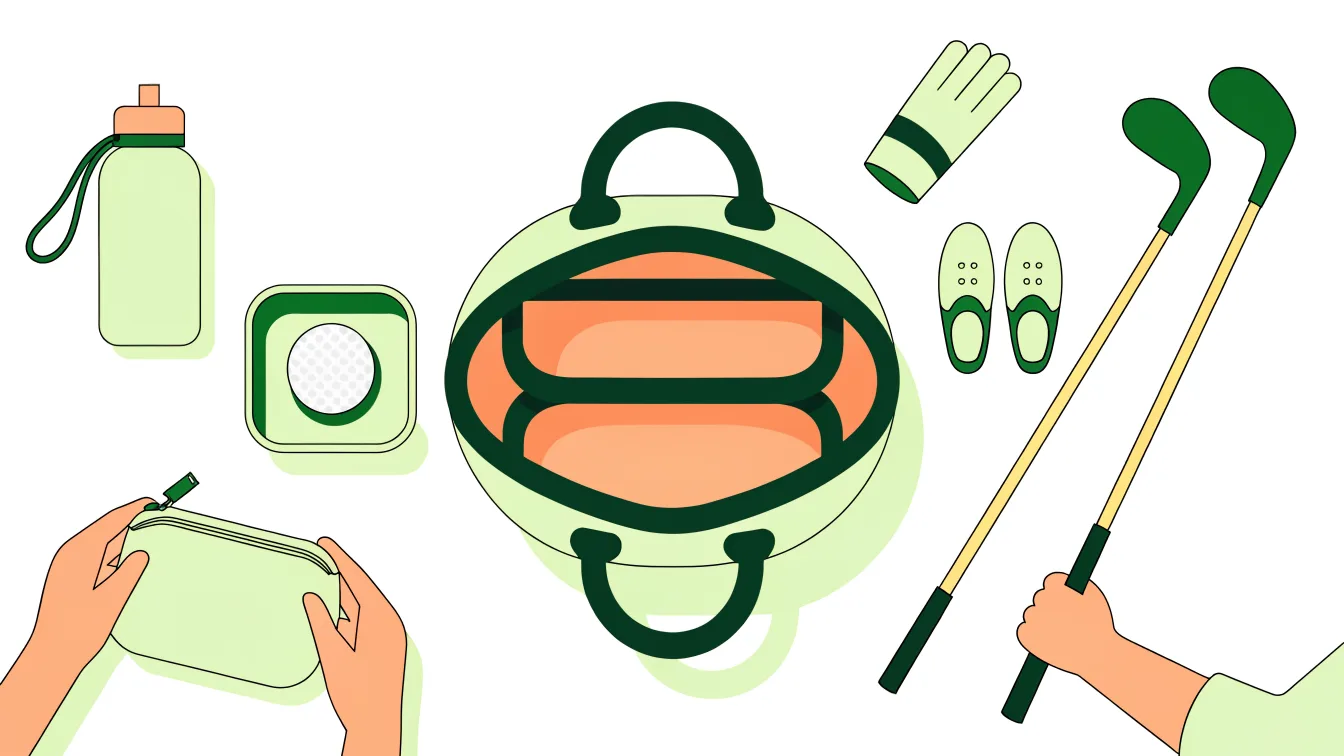
Put frequently accessed items where they are not buried beneath rainwear. Keep balls, tees and small tools in dedicated spaces. Protect electronics from loose metal objects.
Separate damp towels from clean clothing when possible, and dry them after the round. A rain hood is helpful only if you can deploy it quickly.
Weight distribution can improve handling. Bulky lightweight clothing may fill a larger pocket without making the bag overly heavy.
Dense spare items can be left behind when unnecessary. Cart users should verify that the packed bag remains stable on the platform and that the securing strap cannot loosen during travel.
Materials, weather and care
Golf bags often mix woven fabrics, coated panels, plastic bases and metal fittings. Weather-resistant panels do not necessarily seal all zippers and seams. Check the manufacturer's exact rain-protection description rather than expecting a standard nylon bag to remain dry throughout a storm.
Clean grit from the base and stand hinges, empty wet pockets and dry the bag before storage. Check strap stitching, leg springs, cart contact points and zipper pulls periodically.
Avoid leaving a wet cover over the bag for prolonged storage. Keep leather accents away from improvised cleaners and follow the maker's care instructions.
The bag materials guide explains common fabrics. For general size and luggage questions, see bag sizes and checked luggage.
Which golf bag should you buy?
Walk regularly? Begin with a comfortable, lightweight stand bag.
Use a cart almost every round? A stable cart bag with accessible pocket orientation is the practical starting point.
Carry only a few clubs for quick practice? A Sunday-style bag avoids unnecessary bulk.
Travel by air? Add a properly fitting protective travel cover and check your airline's live policy.
None of these choices requires an expensive tour-bag silhouette. Put the money toward fit, secure hardware and features you will actually use.
FAQ
What is the difference between a stand bag and a cart bag?
A stand bag has deployable legs and a harness intended to make walking and setting it down easier. A cart bag prioritizes stability and storage while mounted on a cart. Some stand bags work on carts too, but their legs and pocket placement must not interfere with the cart's securing system.
Do I need fourteen full-length dividers?
No. Fourteen top openings can keep clubs organized, but they are not necessary for every golfer. Check whether the partitions run the full length if grip tangling matters. The Rules of Golf limit is fourteen clubs; it does not require a fourteen-way golf bag.
Can I check a golf bag on an airplane?
Often yes, under the airline's sporting-equipment policy. For example, Delta and American Airlines publish golf-specific rules.
Requirements vary by route, weight, container and fare. Confirm every operating carrier's current rules before travel and pack the clubs in an appropriate protective cover.
Is a waterproof golf bag necessary?
It depends on how often you play in rain and how you store valuables. Waterproof fabric claims are not the same as whole-bag protection.
Look for the maker's details on seams, zippers and rain hoods. Keep sensitive electronics in a separate protective pouch when the consequences of water exposure are high.
How heavy should a golf stand bag be?
There is no single correct empty weight. Makers publish each bag's weight next to its pocket and divider counts. One stand-bag line lists a 4.8 lb model with a four-way top and eight pockets.
Add your intended contents, adjust the harness and evaluate balance on your own shoulders. A light empty bag packed with extras may still be tiring.