Fishing bags: tackle bags, backpacks and sling packs
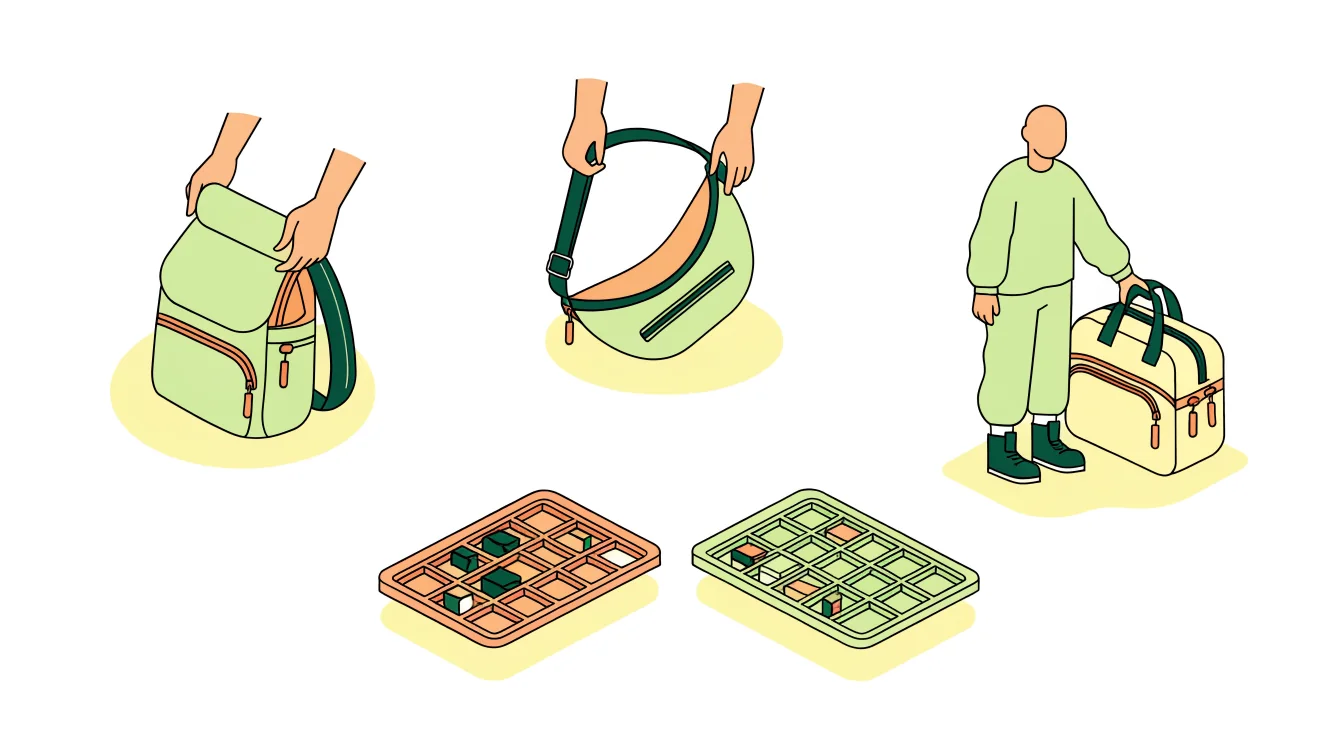
The best fishing tackle bags keep the gear you actually use organized, accessible and secure in your fishing environment. Tray-based shoulder bags work for larger lure collections. Backpacks make long walks easier. Sling packs suit compact kits that must stay close to hand.
Pick a tackle bag by your fishing style
The word tackle covers many shapes of equipment. A bank angler carrying soft plastics, hooks and pliers needs a different system from someone transporting several large boxes to a boat.
A wading angler may need everything close to the torso while keeping hands free. Capacity alone cannot solve access or load comfort.
| Bag type | Best setting | Strength | Weak point |
|---|---|---|---|
| Shoulder tackle bag | Boat, car-to-bank trips | Easy tray access when set down | One-sided carry |
| Tackle backpack | Long walks, shore hopping | Hands-free, distributes load | Reaching contents while worn |
| Sling pack | Light bank fishing, wading | Can rotate forward for access | Limited capacity and one-shoulder load |
| Hip pack | Minimal gear and close access | Keeps shoulders free | Belt fit and small volume |
| Chest pack | Flies, small tools, frequent access | Gear stays in front | Can restrict space for other layers |
| Hard tackle box | Vehicle, boat storage | Structured compartments | Bulky for walking |
| Waterproof roll-top pack | Wet and splash-heavy trips | Better protection when used correctly | Slower access and closure discipline |
If you mostly fish from one stable position, a compartmented bag you can open on the ground is convenient. If you move every few minutes, a small sling or backpack may reduce repeated packing. If you fish near water deep enough to soak your gear, protective lining and closure quality are more important than another accessory pocket.
Understand 3600 and 3700 tackle tray sizes
These numbers are useful only when the bag and tray maker identify a compatible series. They are not a universal measurement language across every manufacturer. Plano's FAQ explains its organizer families and dimensions.
| Plano tray family | Approximate footprint reported by maker | General packing role |
|---|---|---|
| 3400 | 8.25 × 4.25 in or smaller | Small parts and compact kits |
| 3500 | 9.00 × 5.00 in | Light tackle assortments |
| 3600 | 10.75 × 7.25 in | Everyday lure and terminal tackle |
| 3700 | 14.00 × 9.00 in | Larger collections and longer lures |
Actual tray thickness, latch geometry and bag access opening also matter. A sleeve designed around one 3700 tray may not accept a differently proportioned box, even when the nominal series is the same.
Measure the tray's maximum outside thickness and the actual interior opening of the bag. If you use unusual lures, measure their lengths and hook arrangements before choosing a shallow divider pattern.
Why the included trays matter
Some fishing tackle bags include several trays, while others sell organizers separately. A listing that says “3700 bag” may ship with no trays, one tray or a full set. Check the exact included accessories on the maker's current listing before comparing prices.
Look for secure tray retention inside the compartment. A bag with an enormous main chamber may still be inconvenient if boxes slide around and their lids catch on fabric. A few accessible trays beat a stack of organizers that all have to come out to reach the bottom one.
Tackle backpacks: what actually matters
The first benefit of a backpack is the ability to carry equipment with both hands free. This matters when walking paths, moving between shoreline spots or carrying a rod and landing net. The second is organization: a structured tackle compartment can hold trays vertically while smaller pockets separate line, tools and personal items.
Check the harness before the pocket count. Wide padded straps should adjust for the expected load.
A chest strap may help stabilize a pack on rough ground. A useful hip belt can transfer some load when the pack design supports it, but a decorative waist strap is not the same as a proper load-bearing system.
Backpack checklist
- Does the main opening reveal the trays without emptying the whole pack?
- Can you safely place the bag on damp ground without soaking the fabric bottom?
- Is there a secure location for tools with sharp edges or hook points?
- Are rod holders positioned so protruding rods avoid low branches and people?
- Can you reach a water bottle without opening the tackle compartment?
- Is the weather protection defined clearly by the maker?
A tackle backpack filled with heavy lead weights, boxes and wet accessories can become tiring. Trim unused gear instead of automatically choosing the largest available pack. For general harness adjustment, consult how to pack a backpack.
Sling packs: keep the kit compact
A sling pack sits across one shoulder and can often rotate toward the chest for access. It is a practical shape for a short lure selection, tools and a few personal items.
It becomes less appealing when heavily loaded. The one-sided strap is not a substitute for a balanced two-strap backpack when carrying substantial weight over distance.
Inspect whether the bag can be worn on the preferred shoulder and whether the strap rubs against a life vest or other gear. Try the rotation motion with a normal fishing jacket. If access requires twisting your body sharply or loosening several buckles, the advertised convenience may not match real use.
Small pockets should have secure closures. Hooks, split rings and swivels can catch in an exposed mesh panel.
Use internal small containers for loose terminal tackle. Be especially careful about exposed sharp hooks around children, pets and other anglers.
Organize by how often you use each item
Organizing tackle by lure family can work well when packing at home, but access priority matters on the water. Keep frequently changed leaders, pliers and selected lures easiest to reach.
Store backups deeper in the bag. Separate dry clothing, snacks and electronics from wet or sharp tackle.
| Gear | Suggested location | Reason |
|---|---|---|
| Pliers and line cutter | Secured exterior loop or tool pocket | Fast access with retention |
| Daily lure selection | Top organizer or most accessible tray | Fewer full-bag openings |
| Extra line and leaders | Protected internal pocket | Limits tangles and contamination |
| Hooks and small hardware | Closed organizer cells | Prevents spills and snagging |
| Rain shell | Upper soft compartment | Available before weather worsens |
| Phone and keys | Sealed inner pouch | Redundant splash protection |
| First-aid kit | Clearly marked accessible pocket | Less searching when needed |
This is a layout suggestion, not a safety rating. A bag without suitable tool retention may require separate sheaths and containers. If a tool has a sharp point, protect it before placing it near fabric, inflation gear or your hands.
Waterproof, water-resistant and draining bags

Many fishing tackle bags use coated fabrics, water-resistant zippers or a rain cover. None of those features alone proves the bag can be submerged.
A waterproof material can be stitched into a bag whose seams leak. Some waterproof roll-tops require a specific number of folds and careful closure to perform as intended.
For boat use, choose a bag that can be secured so it does not slide or obstruct movement. A hard or semi-rigid base may help keep it upright.
For wading, prioritize a securely attached bag and avoid overloading any strap or belt. A bag that drains quickly may be more appropriate for wet gear than an airtight bag that traps water inside.
Protect electronics separately
A waterproof pouch inside the main bag provides useful redundancy. Even a well-made waterproof outer bag can suffer punctures, closure mistakes or wear.
A floating phone case and a simple dry pouch solve different problems; do not assume either replaces appropriate personal safety equipment near water. Check the manufacturer's use conditions.
See waterproof bags and waterproof vs water-resistant for the difference between ratings, coatings and closures.
Materials and construction for fishing conditions
A maker's denier number describes yarn mass, not complete durability. Tackle bags often advertise heavy fabrics such as 1680 denier alongside a molded base and exterior pockets.
A high denier does not by itself make a bag more abrasion-resistant than a lighter-denier alternative. Coating, weave, reinforcement and use matter; see bag materials for what denier does and does not tell you.
Inspect zipper tracks and pull tabs for grit. Examine stress points at strap anchors and tray-compartment corners.
Check whether the bottom stays stable on uneven ground and whether the fabric traps sand or fish residue. On a boat deck, the underside should wipe clean and not slide.
Care in brief: rinse off salt and fish residue, empty the trays, and let the bag dry open before storage. Follow the maker's care label; a closed, damp tackle bag is a smell waiting to happen.
Replaceable parts extend practical life. A damaged shoulder strap or buckle should not automatically make the entire bag useless, provided the bag maker offers compatible components and safe repair guidance. Avoid guessing load limits for an attachment that the manufacturer has not rated.
Different settings require different layouts
Bank and shoreline fishing
Look for a bag that carries comfortably over the distance you walk and opens without spilling tackle onto dirt. A backpack can hold extra water, layers and food, while a small sling helps when working with a compact selection. A hard base is useful if the bag is repeatedly set down on uneven ground.
Boat fishing
Secure storage matters more than walking comfort. Use a bag that fits the storage space or sits safely without blocking footpaths and equipment. Avoid loose trays on a rocking deck.
Keep hooks contained and separate moisture-sensitive items. Follow the boat operator's stowage and safety instructions.
Wading and fly fishing
Chest and hip packs can make small tools easy to reach, but they must not interfere with flotation or other essential equipment. A compact sling can work when the load is light.
Choose closures that can be operated with wet hands and assess how the bag behaves if submerged. Never treat a tackle pack as a buoyancy aid.
Family outings
Simple closed organizers reduce the chance of hooks spilling into a shared bag. Keep sharp tackle inaccessible to young children.
Separate food, drinking containers and personal supplies from bait, wet tools and used lines. A small secondary pouch for trash and cut fishing line helps contain mess after a session.
Flying with fishing tackle
Airline equipment rules change, and an airline may distinguish rod tubes from tackle bags. Both policies below were checked November 7, 2026.
American Airlines counts a rod case and an equipment bag as one checked item. If they weigh more than 50 lb together, they are charged as two.
Delta accepts fishing gear up to 115 linear inches as checked baggage in a durable protective container. A rod short enough for its 22 x 14 x 9 inch carry-on standard can go in the cabin.
Always check the current operating airline, airport security requirements and any local rules on fishing tools, sharp hooks and restricted items. Do not assume tackle permitted in checked baggage is acceptable in a cabin bag. Protect rod tips with a suitable case, verify the fully packed outer dimensions and confirm fees before leaving for the airport.
Which fishing tackle bag should you choose?
Before comparing fishing tackle bags, lay out the trays and tools you use on an ordinary outing. If you have several 3700-size boxes and mostly drive to a fishing position, a stable shoulder tackle bag may suit you.
If you walk long distances, prioritize a backpack harness and an organized tray compartment. If you fish light and change spots often, a compact sling or hip pack can be more efficient.
Do not purchase extra capacity merely to store tackle you rarely use. A well-organized smaller bag keeps hooks protected, tools accessible and weight under control. The bag sizes guide can help with liters, while bag materials explains fabric labeling.
FAQ
What does 3700 mean on a tackle bag?
It refers to a common organizer series, not a fixed bag volume. Plano's FAQ lists its 3700 tray footprint at roughly 14 by 9 inches. Actual thickness and shape vary, so confirm that your exact boxes fit the bag's opening and sleeve dimensions before purchase.
Should I choose a tackle backpack or shoulder bag?
A backpack is useful when walking longer distances or carrying several heavy boxes. A shoulder tackle bag can be more convenient when you reach a fishing spot by car or boat and set the bag beside you. Compare loaded weight, tray access and comfort rather than choosing on total pocket count alone.
Is a waterproof fishing bag worth it?
It depends on exposure. A carefully closed waterproof bag can help during wet outings, but claims have specific limits. Check seams, closure instructions and whether the whole bag has a defined rating.
Protect electronics with a separate inner pouch. A water-resistant fabric label alone does not guarantee dry contents.
How do I keep hooks from tangling in a bag?
Use closed compartmented organizers sized for the hooks and lures. Keep loose hardware out of unlined mesh pockets, and protect sharp points before storing tools.
Avoid overfilling trays so their lids close securely. Separate used tackle from clean personal items, and inspect for stray hooks after each outing.
Can fishing rods and tackle travel together on flights?
Sometimes, subject to specific airline counting and packaging rules. American Airlines publishes conditions for rod cases and fishing equipment bags.
Delta publishes its own size and safety requirements. Confirm both the airline and airport security rules for your route before traveling.