Waterproof bags and dry bags: types, ratings and how to choose
Waterproof bags are built to keep water out under defined conditions, but not every bag sold with that label survives immersion. Choose by your actual exposure: rain, spray, splashes, or submersion. Examine seams, closures, and published test ratings together.
What counts as a waterproof bag?
A waterproof bag is designed to resist water passing through its complete construction under a particular set of conditions. That includes more than the fabric. Needle holes, zipper gaps, closure folds, valve ports, and worn corners can let moisture reach the contents.
A water-resistant bag can shed some rain or splashing but should not be assumed to protect electronics in deep water (the labels explained). A waterproof fabric may still be sewn into a bag whose seams are not sealed. A submersible bag needs stronger evidence than a general claim about keeping out rain.
The most useful shopping question is not simply, "Is it waterproof?" Ask, "For which exposure, with what closure, and under what test?" If the maker gives no answer, treat the bag as a splash-management choice rather than an underwater container.
Main types of waterproof bags
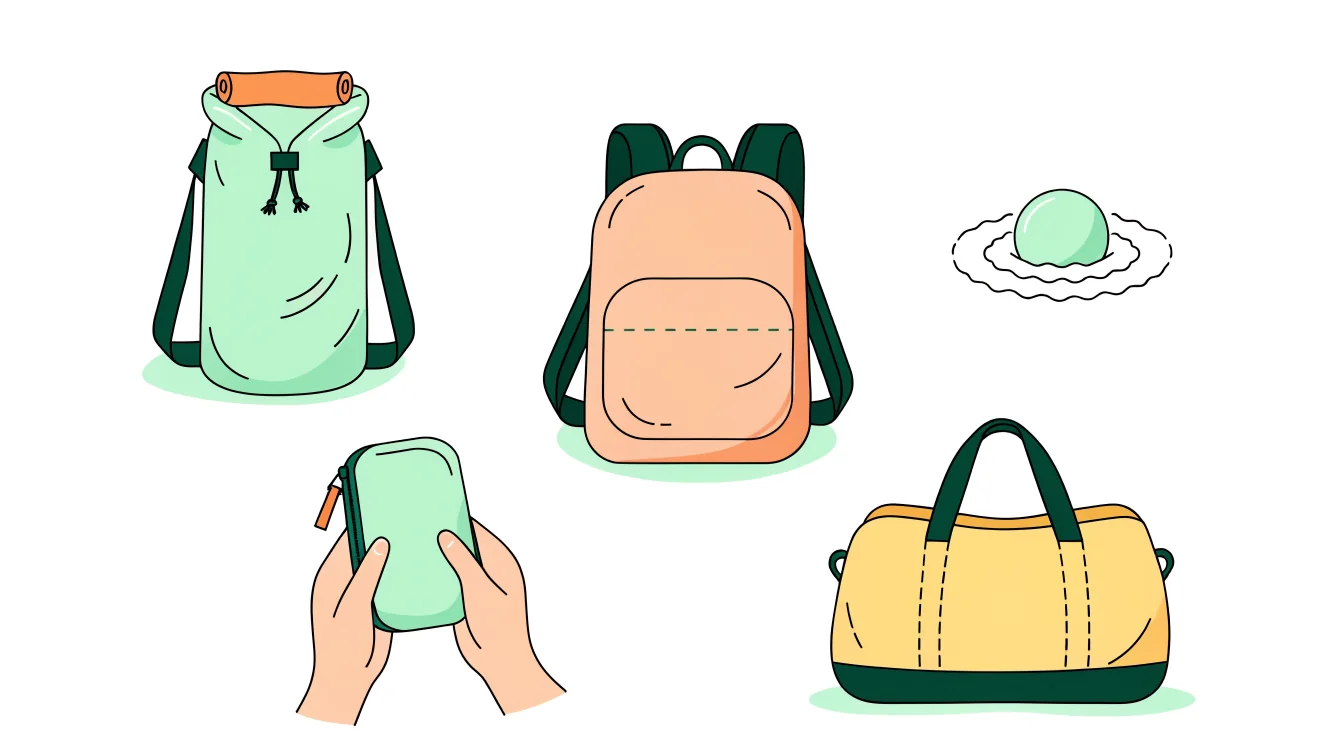
| Bag type | Typical job | Closure or protection approach | Main trade-off |
|---|---|---|---|
| Roll-top dry bag | Clothing and spare equipment on wet trips | Folded roll closure and coated or welded body | Slower access; closure technique matters |
| Dry-bag backpack | Hands-free wet-weather carry | Roll top, sealed construction where specified | Fewer outside pockets |
| Waterproof duffel | Carrying bulky kits between vehicles and boats | Wide opening with specialized zip or roll closure | Large opening can be awkward to seal |
| Waterproof phone pouch | Splash protection for a phone and documents | Gasketed or clamped opening | Touchscreen operation and fit may vary |
| Waterproof pannier | Bicycle commuting and touring | Sealed body with roll or zip closure | Rack compatibility must be checked |
| Pack liner | Backing up a rain-resistant hiking backpack | Separate waterproof interior enclosure | Exterior pockets still get wet |
| Rain cover | Deflecting rain from a conventional backpack | Fitted exterior cover | Openings and back panel may remain exposed |
A dry bag is not always intended to remain submerged. Roll closures may perform very well against rain and splash while allowing water in if held underwater. One maker's roll-top pouch page warns that water may enter through the closure if fully submerged.
For specific options, see best dry bags and best waterproof backpacks.
How to interpret IP ratings
An ingress protection rating, defined in the IEC 60529 standard, uses two digits. The first concerns dust and other solid particles, and the second concerns water entry under defined conditions. A higher second digit may indicate a different test regime; never reduce the whole rating to a vague promise of "more waterproof."
| Example rating | Meaning shown in cited manufacturer guidance | What it does not prove |
|---|---|---|
| IP53 | Dust-protected; protection from spraying water up to 60 degrees from vertical | Safe immersion |
| IP54 | Dust-protected; protection from splashing water from all directions | Safe immersion |
| IP64 | Dust-tight; protection from splashing water from all directions | Safe immersion |
| IP67 | Dust-tight; protection from temporary immersion up to 1 m for 30 minutes | Unlimited depth or duration |
The level wording above is quoted from ORTLIEB's published rating summary on one of its product pages; the test conditions themselves are set by IEC 60529. Ratings apply to the relevant product and test conditions, not to every bag made from a similar material. The manufacturer's exact rating and closure procedure are essential.
Not every outdoor bag publishes an IP rating. That absence does not prove it fails in rain. It does mean that "weatherproof" or "storm-ready" on a label is marketing language, not a tested rating.
How closures affect water protection
Roll tops
A roll top closes by folding material over itself before securing the ends. The number of folds, direction of fastening, and bag loading all affect the intended seal.
Follow the exact instructions for the bag you own. One maker's roll-top pouch specifies 3–4 rolls, secured downward, for its IP64 rating; that count is not a universal rule.
An overfilled dry bag may not leave enough material to roll correctly. A partly packed bag that traps too much air can also be awkward to close. Practice at home and inspect the top for wrinkles or grit.
Waterproof zippers
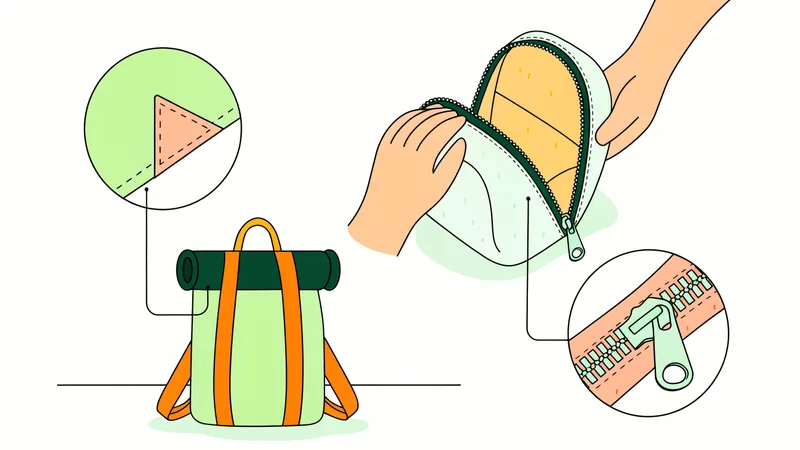
Some specialty bags rely on a protected zipper. Not all water-resistant zippers are watertight, and partial closure can invalidate performance. Examine the product's maintenance and closing instructions.
Keep dirt away from sealing surfaces. A seemingly small gap can matter more than a thick bag wall.
Flaps and drawstrings
These manage rain and access rather than necessarily creating a water barrier. A flap can slow water reaching a zipper.
A drawstring closes an opening but typically leaves a path for water to enter. Use them for exposure compatible with the maker's claims.
Choosing by activity
| Activity | Sensible starting type | Critical check |
|---|---|---|
| Walking commute in rain | Weatherproof or rated backpack | Zippers, laptop compartment, seams |
| Cycling commute | Waterproof pannier or suitable backpack | Mounting, visibility, closure |
| Hiking in variable weather | Ordinary pack plus protected inner liner | Total pack fit and liner closure |
| Day at a beach | Washable bag plus separate dry pouch | Sand cleanup and valuables protection |
| Kayaking or canoeing | Suitable dry bag secured inside craft | Whether exposure includes immersion |
| Boat transfer | Dry duffel or dry bag | Carry handles and securing points |
| Storing spare clothes at camp | Dry bag inside luggage | Closure and abrasion protection |
| Carrying a phone near water | Specifically rated phone pouch | Device fit and tested water conditions |
Think about the consequence of failure. A damp towel is an inconvenience; a wet passport or phone may disrupt the entire trip. High-value or essential contents deserve a second layer of protection, even if the main bag has a credible rating.
What size dry bag should you buy?

Liters describe volume, not shape. Size the bag to the gear it will hold, plus the material needed to roll the top closed. A roll-top filled to the brim leaves nothing to roll, so plan on using less than the stated liters.
| Planning range | Possible use | Fit check |
|---|---|---|
| 1–3 L | Keys, small accessories, compact first-aid items | Confirm object dimensions and pouch closure |
| 5–10 L | Light change of clothes | Leave roll-top clearance |
| 10–20 L | Spare layers and a towel | Check stuffed diameter |
| 20–35 L | Bulky clothing or shared day gear | Consider carrying comfort |
| 35 L and above | Multi-person or overnight gear | Check handles and loaded weight |
These are approximate planning ranges, not model-specific capacities or safety certifications. A sleeping bag can occupy more volume than several outfits, while a camera kit requires protective padding that adds bulk. Use the dimensions of actual gear for the final decision.
A compression dry bag adds another function: shrinking flexible contents. But compression does not reduce weight, and it may put more stress on seams or straps. Follow the product's instructions rather than using it as a substitute for ordinary fit checks.
Waterproof fabrics, seams, and coatings
Fabric matters, but a finish alone does not define the bag's protection. Coated nylon and polyester can be useful choices, while thicker films and molded constructions may behave differently at folds.
Welded seams join layers without conventional needle perforations. Sewn seams may rely on seam tape or coatings, whose wear and care requirements depend on the product. Reinforced corners can reduce abrasion where a bag rests on rough surfaces.
Do not equate a thick material with an automatic waterproof rating. Likewise, a light material is not necessarily ineffective. Look for a published construction description and protection claim tied to the finished product.
A bag can also have weather-resistant external fabric but unprotected pocket openings. Pay attention to where you plan to place electronics. A protected main compartment cannot guarantee that a loosely zipped front pocket stays dry.
Protecting electronics and documents
Use a properly sized inner waterproof pouch for a phone, passport, camera batteries, or essential documents. Check whether the specific pouch is designed for the expected conditions. Inspect seams and the closure before each outing.
Keep wet towels and swimwear away from the phone pouch; moisture sitting against the seal is the easiest way in. If you use a power bank, follow its handling and transport instructions, including airline battery rules when flying.
Test a new pouch empty, following the maker's directions, before trusting it with a phone or passport.
Cleaning and storing a dry bag
Remove sand and grit from closure surfaces. Rinse or wipe the bag according to the care instructions, then let the inside and outside dry. One maker's care directions for a coated pouch call for warm water and mild soap, then complete drying before storage.
Avoid household solvents and abrasive brushes unless specifically allowed. Harsh cleaning can affect coatings, printed surfaces, sealing materials, or adhesive treatments.
Storage instructions also differ. The same maker warns against storing that pouch rolled or folded because the coating may crack.
Some dry bags are made to pack down, so follow the care page for your own bag.
Check closure buckles and coated folds before the next trip. Replace or professionally repair a bag with damaged seams when its protective function is critical.
Common buying mistakes
Mistaking water resistance for submersion protection. Product descriptions may emphasize rainy commuting while saying nothing about water pressure. If no immersion rating is published, assume the bag is for rain and splashes only.
Ignoring the closure. Even a well-sealed fabric body can fail when a roll top is fastened incorrectly or a zipper is left slightly open.
Buying only by liters. A narrow 20-liter bag may not fit a broad camera insert. Compare internal dimensions and closure clearance, not only headline capacity.
Forgetting the carry method. A waterproof sack without comfortable straps can be frustrating on a long walk. Put load handling alongside water performance in the decision.
Assuming a rain cover makes the entire pack waterproof. Water can reach back panels and gaps. REI recommends an internal liner as an additional way to protect gear.
The simplest buying decision
Choose rain-resistant construction for everyday showers when the consequences of leakage are low. Choose a properly closed dry bag for repeated splashes and boating conditions within its claims. Choose a specifically immersion-rated product when temporary underwater exposure is realistic, and read its limits carefully.
Your bag's total usefulness depends on both protection and carrying comfort. If the load is heavy, compare a waterproof backpack with a conventional hiking backpack and a protected inner liner. If access matters, determine whether a roll top will slow you down.
Before purchasing, check the official product page for rating, seam construction, closure instructions, care, and warranty. Keep a second protective layer for irreplaceable items.
FAQ
Can a dry bag be submerged underwater?
Not automatically. A roll-top can resist rain and splashing while allowing water through under immersion.
One maker warns that water may enter its roll-closure pouch when fully submerged. Buy for the maker's documented exposure rating, not the category name alone.
What is the difference between IP64 and IP67?
IP ratings come from the IEC 60529 standard. In ORTLIEB's published rating summary, IP64 is dust-tight and splash-protected. IP67 adds protection against specified temporary immersion, up to 1 meter for 30 minutes.
These ratings have different test conditions. Read the exact product rating and required closure procedure.
Are waterproof backpacks better than rain covers?
A correctly constructed waterproof backpack can offer more complete integrated protection, but fit and pocket accessibility matter. Rain covers are useful for reducing surface wetting, while inner liners protect contents if water gets through. The right system depends on exposure and the consequences of leakage.
What size dry bag do I need for clothes?
Lay out the clothing first and estimate compressed volume. Small kits may fit a few liters; bulky cold-weather clothing takes far more room.
Leave enough unfilled space for the closure method. If the manufacturer provides actual dimensions, use them rather than guessing from liters alone.
Do waterproof bags need special cleaning?
Follow the manufacturer's instructions. For one maker's coated pouch, recommended care includes mild soap, gentle cleaning, and full drying.
Avoid assuming all coatings tolerate the same cleaners or storage folds. Dirt trapped in a closure can compromise its seal.
Related guides
Guides in this section
2 guides sit under this page.