Cooler bags: types, sizes and how to choose
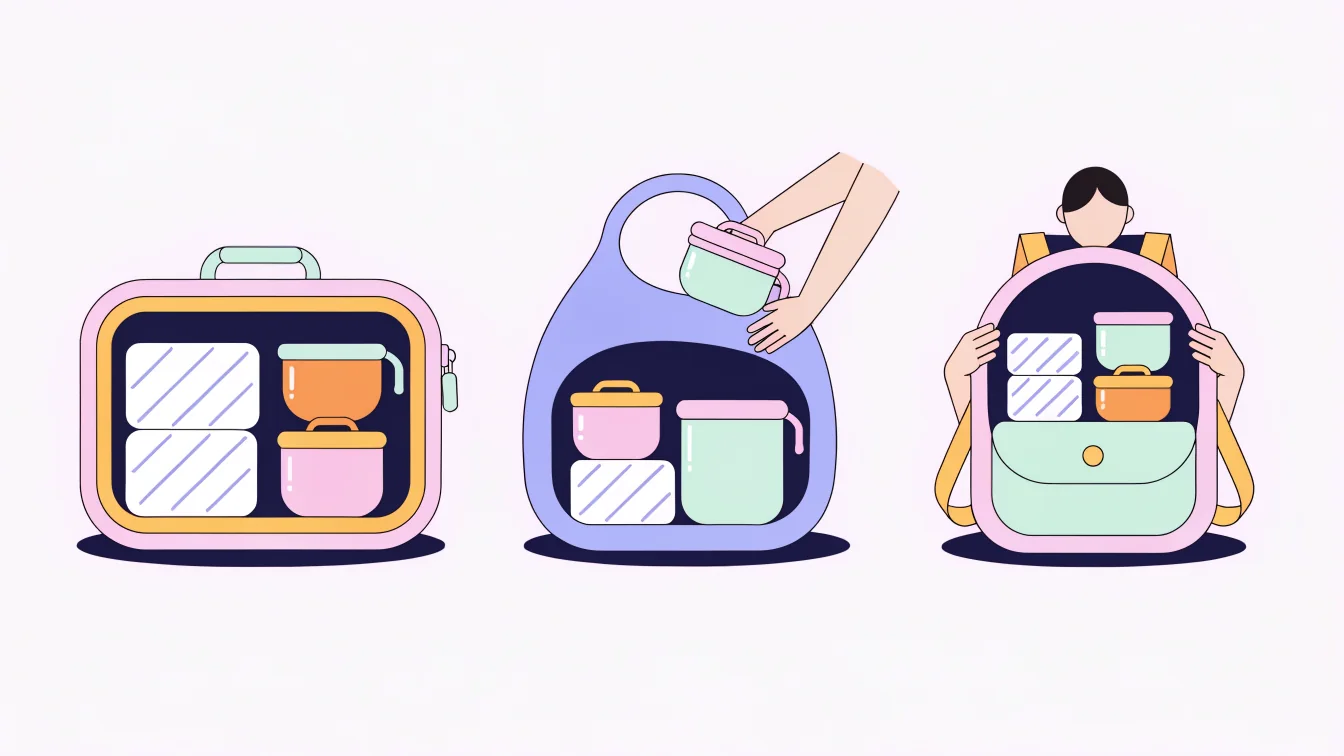
Choose cooler bags by what must stay cold, how long it travels and how you carry it. A lunch bag, a soft cooler tote and a backpack cooler solve different problems. Insulation slows warming; safe food temperatures depend on prechilling, cold packs, packing and conditions.
Types of cooler bags: match the format to the trip
A cooler bag is a portable insulated container. It slows heat entering its interior, typically with foam or another insulating layer between an outside shell and inner liner.
A cooler bag makes no cold of its own; it only slows warming. What matters is not whether it looks outdoorsy but whether your packing plan keeps food at a safe temperature.
| Type | Typical use | What it carries well | Main drawback |
|---|---|---|---|
| Insulated lunch bag | Office, school, short commute | One meal and cold packs | Limited depth and ice capacity |
| Lunch box with rigid structure | Stacked containers | Food containers that must stay upright | Bulky for the capacity |
| Soft cooler tote | Picnic or shopping run | Containers and loose drinks | Single-shoulder load can feel heavy |
| Cube-shaped soft cooler | Tailgate or short car outing | Boxed meals and multiple drinks | Takes space even when near empty |
| Backpack cooler | Walking to beach or campsite | Hands-free drinks and food | Heavy when filled; warm against back |
| Rolling soft cooler | Level parking lots and events | Group supplies | Wheels and handle add weight |
| Hard cooler | Long vehicle trips | Larger ice volume and rigid protection | Less flexible to store and carry |
A soft cooler makes sense when portability matters. A rigid cooler may be easier to pack with large ice blocks and can protect fragile containers. Neither is automatically safer for food without a temperature plan.
Powered coolers are outside this guide; follow the maker's manual for those.
How much cooler capacity do you need?
Cooler sizing is confusing because makers may describe the interior in liters, beverage cans, or overall dimensions. These are not interchangeable measures.
A can count may exclude ice or use an assumed packing pattern. Read the exact qualifier beside the number.
The ranges below are planning starting points, not performance specifications.
| Use case | Capacity range to investigate | Packing priority | Common oversight |
|---|---|---|---|
| Single packed lunch | 3–7 L | Meal plus two cold sources | Ice pack crowds out food |
| Two lunches or long workday | 7–12 L | Containers in one layer | Bag too tall for locker |
| Picnic for two | 12–20 L | Food upright, drinks accessible | Lid constantly opened |
| Small family outing | 20–30 L | Food and drink divided | Fully loaded bag too heavy |
| Group day trip | 30 L and up | Separate bags for food and drinks | Ice replaces usable volume |
Measure the actual containers. A nominal 12-liter bag may not hold a wide rectangular food box if its opening is narrow. A cooler with 10 inches of internal height cannot fit an 11-inch upright bottle, regardless of volume.
List the food, drinks and cold packs and plan where each sits: heavy bottles at the bottom, crushable food in lidded containers. For a long hike, split the load across two people rather than one oversized backpack cooler.
Insulation, seams and closures
Insulation reduces heat transfer, but it cannot promise a specific temperature without a defined test setup. Warm food placed into a cool bag may remain warm. Start with chilled contents and cold sources where the food requires refrigeration.
| Construction detail | What it changes | What it does not prove |
|---|---|---|
| Thick insulating wall | Can slow heat transfer | A universal number of cold hours |
| Wide top opening | Makes loading easier | Spill protection |
| Gasketed zipper | May improve sealing | Any unspecified submersion rating |
| Roll-top closure | Fewer obvious zipper gaps | Automatic waterproof certification |
| Welded liner | May reduce leaking at seams | That the outside is fully waterproof |
| Removable liner | Easier separate cleaning | Food-safe temperature by itself |
A waterproof outer surface does not necessarily mean meltwater stays inside. Conversely, a leak-resistant liner may retain water while the exterior fabric absorbs rain. Check the official description for exact wording and exceptions.
On zippered models, check the closure-care instructions. Dirt, sand and salt make a tight zipper hard to work, and a sealing zipper is often stiff by design. Forcing it at an angle can damage it, so follow the maker's cleaning and lubrication steps.
How to pack a cooler bag for safer food
The USDA advises packing refrigerated perishables into a cooler with ice or gel packs to maintain 40°F or below. Treat that temperature as a food-handling guideline, not a feature guaranteed by a bag's marketing copy.
- Chill the food first. USDA advises moving perishable foods directly from the refrigerator or freezer into a cooler. Do not expect ice packs to cool warm food rapidly.
- Freeze adequate cold packs. Use ice or gel packs suitable for the trip and the volume of food.
- Pack tightly without crushing food. Avoid large empty gaps, but leave space for the required cold sources.
- Put foods in sealed containers. This reduces spills and contamination from cooler meltwater.
- Keep frequently used drinks accessible. Repeatedly opening a shared cooler lets warm air in.
- Check temperature. A food or cooler thermometer provides information a timer cannot.
- Return perishables to refrigeration promptly. Do not leave them out longer than USDA's time limits below.
USDA advises against keeping perishable foods out for more than two hours, or one hour in temperatures above 90°F. Treat those limits as general guidance, not a feature of any bag.
Children's lunches, dairy, meat dishes and cooked leftovers all need the same temperature discipline. Crackers and other shelf-stable snacks need no cooler at all.
Why 'keeps ice for days' is not a universal promise

Cold-retention claims depend on outside and starting temperature, the quantity of ice, the ratio of ice to contents, and how often the bag opens. A claim without test conditions is hard to compare fairly.
When evaluating a manufacturer's retention statement, ask whether it specifies ambient temperature, ice-to-food ratio, loading method and number of openings. Do not transfer the result to a different model from the same brand.
Some cooler pages use can capacity as the headline metric. One maker rates two backpack coolers at up to 20 and 36 standard 12 oz cans, counted with cans only and no ice. For food trips, leave room for cooling materials instead of treating the full beverage figure as functional meal capacity.
A thermometer is more informative than a claimed retention duration. If you cannot verify the temperature of a perishable meal after an extended trip, do not assume the bag's insulation protected it.
Cooler backpack versus cooler tote
Choose a backpack cooler for a walk, crowded transit or locations where both hands must remain free. The weight is carried closer to the body's centerline and across two shoulder straps. Its downside is reduced access while worn, and a large filled cooler can be uncomfortable on a hot day.
Choose a tote for short distances, loading into a car and frequent access. Its opening usually makes it simpler to organize containers at a picnic table. A heavily loaded single-shoulder cooler can dig into the shoulder, however, particularly when bottles shift.
The best way to decide is to load the bag you are considering with a similar weight and carry it for a few minutes. Check whether the base rubs your legs, the handles leave enough clearance, and the lid is accessible while the bag sits upright.
For mixed trips, a small lunch bag inside a larger daypack may be simpler than a dedicated cooler backpack. See insulated lunch bags for adults and cooler bags and soft coolers for more specific buying lists.
Materials, cleaning and odor prevention
A soft cooler often combines several materials: woven exterior fabric, insulation foam, a coated or molded interior and specialized zippers. Read the care label for every layer. A machine-washable-looking exterior does not mean the insulation or liner tolerates machine agitation.
Clean spills promptly the way the maker approves. One maker's soft-cooler care page recommends mild dish soap, water, a gentle cloth on the inside, outside and zipper, and drying completely before closing. Treat it as an example; your bag's label rules.
Pay attention to folds near the zipper and the bottom corners, where liquid can remain. Air dry fully with openings exposed.
Closing a wet cooler for storage invites unpleasant smells. Do not use heat, bleach, strong solvents or abrasive brushes unless the maker explicitly permits them.
For an attached shoulder strap, inspect stitching and connection points. A loaded cooler gets heavy fast once it holds liquid, ice and food.
A stated capacity in cans is not a safe lifting-load rating. Check whether the maker publishes a maximum load; if it does not, do not overpack.
Buying checklist and mistakes to avoid
Before buying, compare these five features: usable interior dimensions, closure design, carry style, cleaning procedure and the manufacturer's exact leak claim. Then confirm that the pack can hold both the food and enough cold sources.
Four mistakes to avoid:
- Treating a water-resistant exterior as a leakproof interior.
- Putting hot food in and hoping the insulation will chill it.
- Judging food safety by ice-retention advertising.
- Buying a huge bag for a two-container lunch; empty space makes packing harder.
A soft cooler earns its space when it matches a repeated routine: one lunch each workday, a short grocery trip, a weekly picnic. If it will not store neatly or is unpleasant to carry full, its insulation claim may not matter.
FAQ
How long do cooler bags keep food cold?
There is no universal duration. Outdoor temperature, contents, ice quantity, closure and opening frequency change performance.
For perishable food, the relevant question is whether it stays at 40°F or below, as advised by USDA. Use a thermometer instead of guessing from a maker's ice-retention claim.
Is a soft cooler bag waterproof?
Not necessarily. An insulated fabric shell can resist splashes while its zipper or seams leak.
Some models advertise a leakproof liner or closure, but the wording and exclusions vary. Read the precise manufacturer statement and avoid assuming that a soft cooler can be submerged.
How big should a cooler bag be for two people?
Measure the meals and drinks, then add room for ice or gel packs. Roughly 12–20 liters is a starting range for a picnic for two, as in the table above, but container dimensions decide it. Check the interior opening, not just the published liter number.
Can you put ice directly in a cooler bag?
Only if the maker allows loose ice and describes the interior and closure as suitable. Some soft coolers are designed to contain meltwater; others are merely insulated fabric lunch bags. Sealed ice packs minimize loose meltwater and are often simpler for packed meals.
How do you clean a cooler bag?
Follow the model's care instructions. Where approved, wipe surfaces with mild soap and water, rinse, and leave the bag open until completely dry.
Inspect seams and closure grooves for residue. Avoid machine washing, heating or strong cleaning products unless explicitly permitted by the manufacturer.
Related guides
Guides in this section
1 guides sit under this page.