Wine and bottle bags
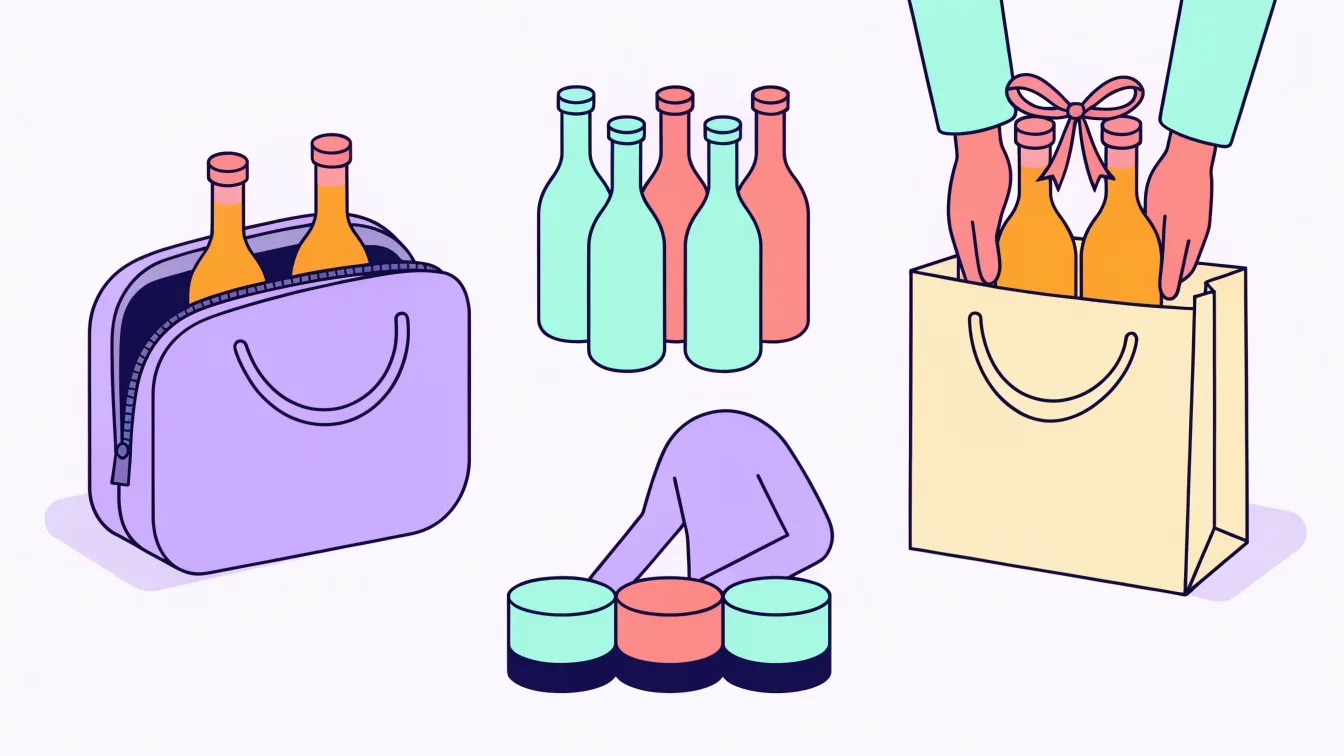
A wine bag should match the bottle's dimensions and the journey. Choose gift packaging for presentation, an insulated carrier when insulation is needed, and documented protective packaging for baggage handling. Bottle count alone does not establish fit or protection.
Which wine bag format matches the occasion?
Begin with the job: presenting a bottle, carrying it to dinner, organizing several bottles, or packing for a flight.
Published constructions include a gusseted paper bottle bag, an insulated single carrier, and an insulated tote with a removable six-bottle divider. Paper packaging, single carrier, divided tote
Use those differences to organize your shortlist.
| Format | Intended job to assess | Feature to examine | Claim you still need |
|---|---|---|---|
| Paper or fabric gift bag | Presenting a bottle | Base, opening, and complete bottle fit | Any stated load or transport limitations |
| Insulated single carrier | Taking one bottle with you | Interior dimensions and insulation | Suitability for your bottle |
| Insulated double carrier | Carrying a pair | Individual spaces and closure | Compatibility with both bottles together |
| Divided multi-bottle tote | Organizing several bottles | Divider layout and carrying method | Permitted loaded weight |
| Dedicated travel packaging | Handling within checked luggage | Bottle restraint and packaging instructions | Documented suitability for that use |
These categories are not interchangeable guarantees. Choose the format for the journey, then examine its specifications.
The cooler bags guide explains related insulated-carrier choices.
Keep presentation separate from transport in your decision. An attractive outer bag should not substitute for the protection your journey requires.
How do bottle counts compare with actual dimensions?
Measure the complete bottle, including the closure and any presentation box. Record height and the widest diameter.
If you plan to use a protective sleeve, measure the sleeved bottle as well. For several bottles, compare each position with its actual contents.
Published examples show different scales of carrying space.
| Published example | Listed dimensions, inches | Stated bottle accommodation | Other fit detail |
|---|---|---|---|
| Single insulated carrier | 3.75 x 3.75 x 11.5 | One standard-size bottle | Overall dimensions rather than a guaranteed internal cavity |
| Double insulated carrier | 8.3 x 4.5 x 12.8 | Two 750-milliliter bottles | Confirm the specific bottle shapes |
| Six-bottle insulated tote | 14 x 13 x 14 | Six-bottle layout | Removable divider listed separately |
Sources: single carrier, double carrier, six-bottle tote.
A volume label should not replace measurement. Two bottles containing the same quantity need not be treated as identical shapes when selecting a carrier.
For a hypothetical gift box measuring 4 x 4 x 14 inches, compare the entire box with the opening and interior.
Do not choose from exterior height alone. Ask for usable space when the listing does not provide it.
What is the difference between insulation and padding?
Treat insulation and physical protection as separate selection requirements. Look for a description of each in the complete carrier.
The six-bottle example specifies insulation, a padded removable divider, and a removable water-resistant liner. Construction details
That identifies components. It does not establish a drop rating, leakage guarantee, or a particular number of hours at serving temperature.
For a picnic, decide how you will prepare the bottle and whether cooling materials must fit beside it. Follow the carrier's instructions.
For checked luggage, seek packaging specifically intended for that use and follow its packing method. Do not infer baggage protection from an insulated-tote description.
Read any temperature-retention claim with its stated conditions. If the maker supplies no relevant duration, avoid planning the trip around one.
Likewise, treat a liner's water-resistance wording precisely. It is not automatically a promise that liquid cannot escape through the closure.
Keep the practical questions separate: does the bottle fit, how is it supported, and what temperature arrangement do you need?
Choose only after the specifications address the requirements that matter to your journey.
How should dividers, closures, and carrying handles work?
Plan one suitable position for each bottle. Include any protective sleeves and the accessories you intend to carry.
A multi-bottle example uses a removable divider, while a two-bottle example has a magnetic closure and an accessory pocket. Divider construction, double-carrier layout
Use the published layout to decide what belongs inside. Avoid treating an accessory pocket as spare bottle space.
Compare the closure with the complete packed arrangement. It should operate as intended without relying on a bottle protruding beyond the stated carrying configuration.
Also decide how you will move the load. Include walking distance, stairs, and transfers between a vehicle and the destination.
Request a published load limit where the carrying weight matters. A six-position divider describes bottle organization, rather than a general weight allowance.
For occasional single-bottle trips, choose an arrangement suitable for that reduced load. Do not assume unused compartments can be packed arbitrarily.
Follow attachment and carrying instructions for any shoulder strap or trolley. Evaluate the complete system with your intended contents before relying on it for travel.
Which materials and cleaning instructions matter?

Read the complete material description rather than the headline fabric. Check the lining, insulation, divider, base, and handle arrangement separately.
The single-bottle example lists polyester, jute, canvas, and leatherette in its material content. The double carrier lists leatherette, foam, and stainless steel. Single-carrier materials, double-carrier materials
Use those descriptions to obtain the right care instructions. Do not infer washing compatibility from one visible panel.
For the cited insulated carriers, the published care method is surface washing with a damp cloth. Single-carrier care, multi-bottle care
Follow the instructions for the exact model and any removable parts. Remove bottles and accessories before cleaning.
After use, inspect the interior and the components that support the load. Obtain repair or replacement advice if a fastening, divider, or handle no longer works correctly.
For a carrier needing treatment beyond the stated routine, contact the maker. Avoid inventing an immersion, machine-wash, or disinfecting method.
Store it in the condition specified by the instructions, ready for the next trip.
What are the rules for alcohol in checked luggage?
Read the label's alcohol by volume, or ABV, before deciding which rule applies. The following summary was checked November 2026.
| Alcohol content | Relevant US passenger provision | Packing implication | Official source |
|---|---|---|---|
| 24% ABV or less | Included in the passenger exception without that provision's 5-liter alcohol limit | Airline baggage and other applicable limits still need checking | 49 CFR 175.10(a)(4) |
| More than 24%, through 70% ABV | Maximum 5 liters per passenger; packaging no larger than 5 liters; unopened retail packaging | Count the total across the passenger's luggage | FAA alcohol guidance |
| More than 70% ABV | Not allowed on passenger aircraft | Do not pack in cabin or checked luggage | FAA packing guidance |
The exception for lower-strength drinks is not an unlimited airline baggage allowance. Confirm the carrier's current acceptance, weight limits, and packaging requirements.
For cabin screening, FAA guidance also notes the separate 3.4-fluid-ounce, or 100-milliliter, container limit for liquids at the checkpoint. FAA checkpoint note
Do not treat a checked-baggage allowance as permission to pass a full-size bottle through ordinary cabin screening.
Rules change. This is general information, not legal advice; review current operator and destination requirements before travel.
How do you choose and pack for the actual trip?
Write a short packing plan covering the bottles, carrier, route, and destination. Separate local hand-carrying from travel involving checked luggage.
For a hypothetical dinner visit, the plan might include two measured bottles, a suitable double carrier, and accessories in their assigned pocket.
For a flight, identify acceptable bottle packaging and confirm the operator's requirements before choosing the outer carrier. Keep the ABV and total quantity recorded.
For example, six hypothetical 750-milliliter bottles contain 4.5 liters in total. That arithmetic alone does not establish permission for any particular journey.
Include every bottle you intend to carry when applying a passenger quantity limit. Avoid applying a fresh allowance to each separate bag.
For a larger tasting load, weigh the complete packed arrangement and compare it with any applicable carrier or operator limit. Follow the equipment instructions when using a trolley.
Keep the closure accessible for inspection, and follow the transport provider's directions.
A wine bag should match that completed plan. Its name, bottle count, or insulation label should not make the decision for you.
FAQ
Will a wine bag fit a champagne bottle?
Measure the particular bottle's full height and widest diameter, including any sleeve or presentation box. Compare those measurements with the carrier's usable compartments and opening. A claim covering standard bottles or two 750-milliliter bottles does not establish compatibility with every bottle shape. Confirm the specific fit before choosing.
Does an insulated carrier prevent bottles from breaking?
Read the protection claims separately from the insulation description. One multi-bottle carrier specifies a padded divider, but that description does not establish a drop or baggage-handling rating. For checked luggage, choose packaging documented for the intended use and follow its instructions. Published construction
Is wine limited to five liters in checked bags?
Check the bottle's ABV. The US passenger exception distinguishes drinks at 24% ABV or less from those above 24% through 70%. The latter category has a 5-liter total limit and unopened-retail-packaging conditions. Airline baggage and other applicable requirements remain separate. Regulation, checked November 2026
Can I wash a reusable bottle carrier?
Follow its exact care instructions, including directions for removable dividers and liners. A two-bottle insulated example permits surface washing with a damp cloth only. Remove all contents before cleaning, and obtain advice before using a treatment beyond the published method. Do not apply that routine to unrelated materials. Care specification
Related guides
Sources
- papermart.com/products/gusseted-paper-wine-bags
- picnictime.com/products/pinot-jute-single-bottle-insulated-wine-bag
- picnictime.com/products/barossa-two-bottle-leatherette-wine-tote
- picnictime.com/products/cellar-6-bottle-wine-carrier-and-cooler-tote
- faa.gov/hazmat/packsafe/alcoholic-beverages
- ecfr.gov/current/title-49/subtitle-B/chapter-I/subchapter-C/part-175/subpart-A/section-…
- faa.gov/blog/clearedfortakeoff/packing-flight-read-fine-print