Pet carrier bags: types, sizes and travel rules
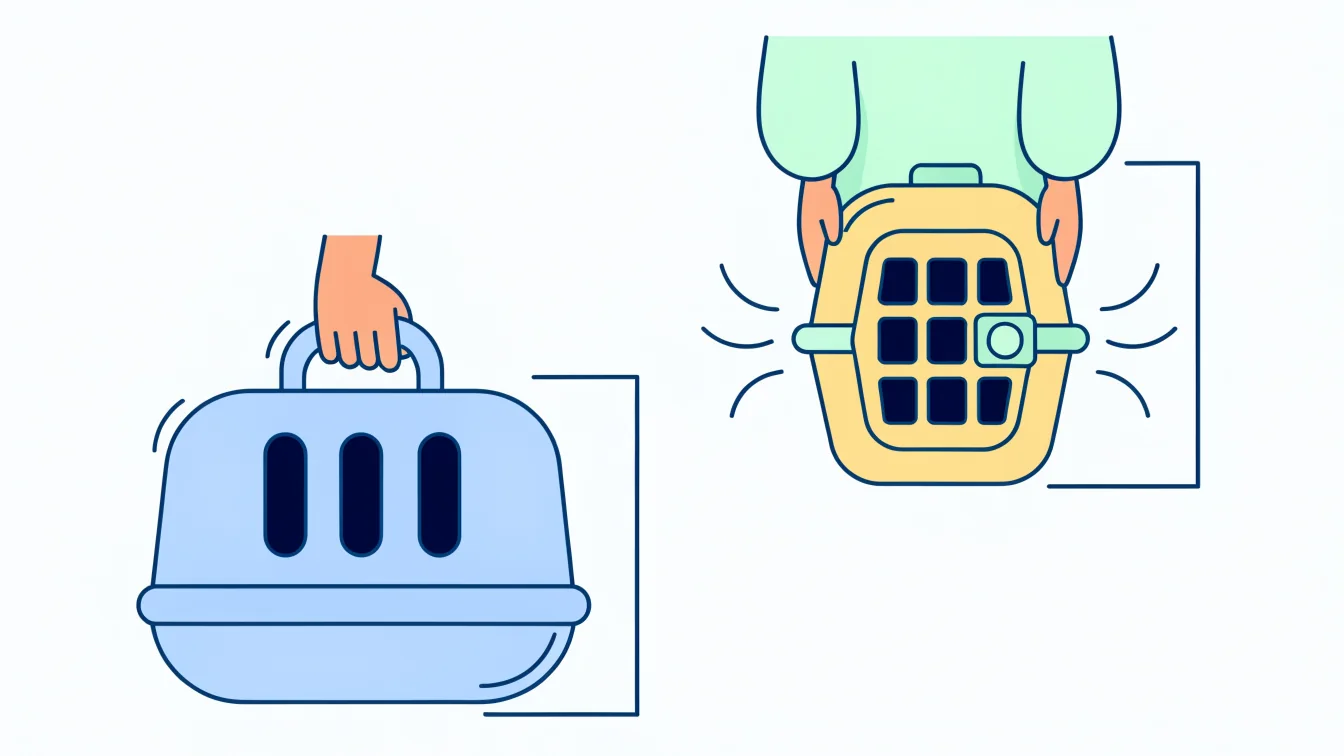
The best pet carrier bags fit the animal comfortably and meet the rules of the specific journey. Size around the pet first, then check ventilation, door security, weight and airline or vehicle rules. An "airline-friendly" label is not proof of acceptance.
What is a pet carrier?
A pet carrier is a fully enclosed bag or kennel for moving an animal. It needs usable room, ventilation and secure closures. A fashion tote with a head opening is not a travel carrier.
Start with the trip, not the style. A cabin flight, a vet visit and a long road trip ask different things of a carrier, and no label covers all three.
Separate three decisions: whether the pet should travel, whether the operator accepts the animal, and whether the bag fits. A veterinarian can help with the first. The airline and the carrier's actual measurements resolve the others.
An expandable compartment is extra space only when its use is permitted. Judge the travel configuration with all required panels closed. If that configuration does not suit the animal, extra floor space at the destination does not fix it.
The main types of pet carrier bags
| Carrier | Useful for | Strength | Limitation |
|---|---|---|---|
| Soft-sided shoulder carrier | Short local trips and some cabin flights | Flexible exterior | Can collapse too far or lack structure |
| Rigid plastic kennel | Road journeys and approved transport contexts | Firm walls and solid base | Bulky; aircraft restrictions vary |
| Backpack carrier | Short walks with a small animal | Hands-free carry | Ventilation and posture need close attention |
| Wheeled carrier | Smooth airport or indoor floors | Easier ground transport | Not accepted for every travel arrangement |
| Expandable carrier | Waiting areas with permitted floor space | Temporary extra room | Expansions must close for transport |
A soft carrier is easier to maneuver with a small cat or dog. Its give is not permission to squash the animal under a seat. The American Airlines policy specifically requires a closed carrier that fits under-seat space without excessive collapse.
A hard kennel can be more appropriate when the journey calls for firm walls. But a hard carrier that meets one aircraft's size limit may not meet another's. An airline can apply different rules to the same animal on separate flights.
Backpack carriers are not automatically comfortable for the pet because the person feels comfortable. Look at how the floor supports the animal, where ventilation panels sit, and whether the animal can maintain a natural position. Seek veterinary guidance for animals with breathing, mobility, anxiety or temperature-sensitivity concerns.
How to measure your pet and the carrier
Measure the animal in its normal standing position. Note nose-to-rump body length, standing height, shoulder width and the space needed to turn.
The goal is not to squeeze the animal into the smallest permitted box. Find a permitted carrier that still allows appropriate movement.
- Measure the pet on a level floor while standing naturally.
- Observe how much floor space the pet uses when turning around.
- Measure the available interior height and length of the proposed carrier.
- Check the closed shape, not the expanded or advertised maximum volume.
- Include external handles, wheels and rigid feet when checking an airline size limit.
- Confirm the carrier's weight rating and the total animal-plus-carrier restriction.
Makers of pet carrier bags often list outside dimensions. The pet needs the inside space; the airline measures the outside. Check both.
| Measurement | Why it matters | Error to avoid |
|---|---|---|
| Interior length | Room for natural rest | Using exterior length as floor space |
| Interior height | Standing posture | Measuring only while the pet sits |
| Floor width | Turning and lying | Assuming mesh sides add usable width |
| Exterior height | Under-seat fit | Ignoring handles or stiff framing |
| Total weight | Operator and handling limits | Checking pet weight without carrier |
Airline travel: what the rules actually say
Flying with a pet starts with the booking, not the bag. Check that the airline accepts your pet's species and age on your exact itinerary before you buy a carrier. Some routes or cabins may not accept in-cabin pets, even when the bag meets a published size.
For example, American Airlines publishes one soft-sided size and two hard-sided limits, one for mainline flights and a smaller one for American Eagle. The table below has the figures. They are that airline's rules, not a US-wide standard.
Under-seat space changes with the aircraft and the seat. A generic personal-item size chart is not a pet-carrier size chart, so use the airline's pet page.
Airlines may also require a pet reservation and a fee; American's are nonrefundable and charged per kennel, each way. Confirm all of it with the operating airline, including on codeshares.
During the flight, keep the carrier closed as the operator requires. Do not assume an expandable side panel can remain open on board. Consider the pet's welfare in the total door-to-door journey, including the drive, terminal time and connections.
Cabin carrier sizes by airline
The following policies were checked November 19, 2026. Dimensions describe the carrier, not a recommended animal size. Permission still depends on the itinerary and the pet meeting the airline's other requirements.
| Airline | Published cabin-carrier dimensions | Other requirements relevant to choosing a bag | Date checked |
|---|---|---|---|
| American | Soft-sided 18 × 11 × 11 inches (recommended for all flights); hard-sided 19 × 13 × 9 inches mainline, 16 × 12 × 8 inches American Eagle | Pet stays in the closed carrier under the seat in front for the entire flight | November 19, 2026. Carry-on pets |
| Alaska | Maximum 17 × 11 × 9.5 inches | Soft-sided only; leakproof, ventilated; shape and integrity must remain intact with the animal inside | November 19, 2026. Contract of carriage |
| Southwest | Not stated on the page checked; confirm with Southwest before you buy | Soft-sided recommended; under-seat space varies by seat type and location | November 19, 2026. Onboard pet guidance |
Southwest says under-seat space may be more limited in some seat types, including aisle seats. Pick the seat before you pick the bag.
Keep a record of the operating airline's answer for each flight. If equipment changes, confirm the carrier again. A connecting flight is a separate fit check, even when the booking was purchased together.
Turning movement requirements into a fit check
Use the airline's animal-comfort requirements alongside its external dimensions. Do not convert a maximum carrier measurement into a maximum pet height. Padding, framing and sloping walls can reduce the space available inside.
| Fit question | What to observe | Source basis |
|---|---|---|
| Is the whole animal inside? | Head and tail remain within the closed carrier | Southwest onboard pet guidance |
| Can the animal stand and move? | Observe natural movement without forcing the sides outward | General comfort check |
| Does the carrier keep its shape? | Check the loaded shape, not only an empty measurement | Alaska contract of carriage |
| For cargo, can the animal stand, sit, turn and lie comfortably? | Assess the usable floor and height of the appropriate crate | AVMA travel guidance |
Make this assessment with the intended liner in place. A thick replacement cushion can change the usable height.
Car travel: containment and restraint

The ASPCA recommends a well-ventilated crate or carrier with room to stand, sit, lie down and turn. It says to secure the crate so it cannot slide or shift in an abrupt stop.
Check the carrier maker's vehicle installation instructions before purchase. Look for a specific securing method that works in your vehicle. A carrying handle or shoulder strap should not be assumed to serve as an approved restraint point.
The ASPCA also advises a series of short drives before a long trip. Ask your veterinarian whether crossing state lines needs a health certificate.
Before a difficult journey, take the carrier's dimensions and photos to your veterinarian and ask whether the trip suits your pet.
A cabin carrier and a car restraint solve different problems. Fitting under an airline seat says nothing about crash performance, so ask for evidence behind any crash-protection claim.
Materials and construction to compare
Judge the whole carrier, not just the fabric. The table below is an inspection checklist, not a ranking.
| Component | Practical inspection | Question before buying |
|---|---|---|
| Fabric shell | Look for wear at seams and floor corners | Can the maker's cleaning method reach every layer? |
| Mesh panels | Inspect attachment and clearance around the animal | Are openings unobstructed in the required travel position? |
| Rigid plastic shell | Check cracks, joints and door alignment | Does the complete kennel meet this journey's requirements? |
| Removable absorbent pad | Check its fit and stability | Can it be removed and cleaned as instructed? |
| Coated or lined floor | Inspect seams and junctions | Does the maker claim leak resistance for the complete floor? |
| Metal or plastic closure hardware | Operate every closure with the carrier loaded | Does it remain securely engaged without distortion? |
For cabin travel, Alaska requires a soft-sided carrier that is leakproof and well ventilated.
Check replacement parts before paying for a complicated design. A removable pad is useful only if the replacement fits correctly. Extra pockets should leave the ventilation panels clear when filled.
Ventilation, closures and floor design
Ventilation panels must remain clear when the carrier is placed as intended. The animal should not have to press against a solid wall to breathe. Avoid designs where exterior pockets or a folded flap cover the primary mesh openings.
Look for secure zipper or latch closures that cannot easily open under movement. The door should close without snagging fur or pressing against the animal. A removable, stable, absorbent floor liner can make routine cleanup easier; it must not create an unstable surface.
The AVMA travel guidance for cargo crates calls for ventilation on at least three sides for domestic flights and a secure locking system. It also asks for room to stand, sit up, turn around and lie down.
Those are sensible targets for a cabin carrier too, even though the AVMA wording is about cargo crates. Ask a veterinarian about any special needs your animal has.
Fit, acclimation and practical use
Before a journey, let the pet encounter the carrier in a calm familiar setting. A carrier should not appear only when a stressful trip begins. Place approved bedding inside, leave the door open under supervision, and allow the animal to explore without forcing entry.
Short supervised trials show the practical problems. Does the floor tip when carried, or does a shoulder strap swing the carrier? Does the animal have to crouch?
If any answer worries you, reconsider the design or ask a veterinarian before travel.
Do not leave a pet unattended in a carrier in a parked vehicle; AVMA guidance says never to leave pets unattended in a car. Never assume a ventilation window compensates for unsafe temperatures. A carrier is transport equipment, not a substitute for supervision.
Cleaning and choosing a long-lasting design
Check the maker's care directions before washing. Remove loose bedding and clean the floor liner separately when allowed.
Dry all parts fully before reuse, particularly absorbent foam or fabric folds. A carrier that stays damp can become unpleasant quickly.
A removable base, a replaceable pad and seams you can reach with a cloth all make cleaning easier. A complex expandable structure is worthwhile only if you will use it safely in settings where expansion is allowed. Avoid decorative features that block the animal's airflow or reduce usable interior space.
Do not treat a torn mesh panel, damaged door latch or cracked rigid shell as a cosmetic fault. Secure containment is essential. Replace or professionally repair compromised transport components according to the manufacturer's guidance.
Which pet carrier should you buy?
- Short car trips and vet visits with a small cat or dog: a soft-sided carrier with a firm base and unobstructed ventilation panels.
- A flight in the cabin: the soft-sided size your operating airline publishes, bought only after the airline has accepted the booking.
- Long road journeys or any transport the airline puts in the hold: a rigid kennel sized to the AVMA stand-sit-turn-lie guidance.
Backpack and wheeled carriers suit short stretches (a walk, an airport concourse), not the whole journey. Expandable carriers only earn their keep where expansion is allowed.

FAQ
What size pet carrier is allowed on an airplane?
There is no single size, because each airline sets its own. Alaska accepts only soft-sided carriers, up to 17 × 11 × 9.5 inches. American recommends 18 × 11 × 11 inches for soft-sided carriers; both were checked November 19, 2026.
Measure the carrier's outside against the airline's limit and the inside against your pet, then confirm for your itinerary.
Are soft-sided carriers better than hard-sided carriers?
Soft-sided carriers can be easier to maneuver and may suit in-cabin travel where approved. Hard carriers hold their shape. Neither is universally better; fit, ventilation, secure closures and transport rules determine the choice.
Can a pet travel in an expandable carrier?
Possibly, but the expanded section generally cannot be relied on for under-seat travel. Assess the closed carrier's dimensions and interior space, and follow the operating airline's policy throughout the journey.
How can I tell if my pet has enough room?
Check whether the animal can maintain appropriate natural positions and turn without being compressed. Measure usable interior dimensions rather than outside measurements alone. A veterinarian can advise on individual mobility or breathing needs.
Does a "fits most airlines" label guarantee acceptance?
No. A label does not replace the airline's approval. The flight, aircraft, route and pet can all affect eligibility.
Check with the operating airline shortly before travel and again if the itinerary changes.
Related guides
- Airline baggage rules for changing flight limits
- Personal item vs carry-on for under-seat sizes
- Travel bags for other luggage decisions
- Bag sizes for measurement basics
- Bag care for material-specific cleaning
Sources
- aa.com/web/i18n/travel-info/special-assistance/pets.html
- ebusiness.avma.org/files/ProductDownloads/mcm-client-brochures-travel-with-pet-2023.pdf
- resource.alaskaair.net/v3/assets/blt2cefe12c88e9dd91/blta6d545d0295aad57/CoC English
- aspca.org/pet-care/general-pet-care/travel-safety-tips
- support.southwest.com/helpcenter/article/traveling-with-pets-onboard-information