Hard-shell vs soft-sided luggage: which should you buy?

Hard-shell vs soft-sided luggage comes down to this: choose hard-shell when rigid protection matters most. Choose soft-sided when you want outside pockets, a front opening and a lighter lift. Then compare the actual case. Empty weight, opening style, expanded dimensions and repair support can matter more than the broad category on its label.
Hard-shell vs soft-sided luggage: the differences that change daily use
Think about the moments you actually use the case: a charger in an airport queue, room for a coat, opening it on a narrow luggage rack.
The table describes common layouts rather than guarantees about every suitcase. Manufacturer guidance distinguishes rigid shells and flexible fabric construction, while opening and pocket arrangements vary by design.
| Attribute | Hard-shell luggage | Soft-sided luggage |
|---|---|---|
| Exterior | Rigid panels; material matters | Fabric over a structure; reinforcement matters |
| Packing access | Often two halves; check for a front opening | Often a front lid with a deeper main compartment |
| Quick access | Do not assume exterior pockets | External pockets are common; check their usable space |
| Protection | Rigid barrier; Samsonite says its softsides offer less rigid protection than hardsides | Flexible panels; pad fragile items yourself |
| Empty weight | Compare the listed pounds; shells vary by material | Compare the listed pounds; Samsonite says its softsides are typically lighter to lift |
| Expansion | Samsonite's guide says almost all hardside cases expand; check the expanded size | The same guide says most softside cases expand; check the expanded size |
| Visible wear | Assess scratches, cracks or dents | Assess abrasion, tears and seam damage |
| Repair | Ask about shells, wheels and handles | Ask about fabric, seams, wheels and handles |
These are buying questions, not results from product testing. bags.net did not test either category. Use the broader bag comparison guides when another construction choice is also unresolved.
Choose hard-shell luggage if…
Choose a rigid exterior when protection and a firm boundary around your packing come first. Travelpro's materials guide explains the rigid-versus-flexible distinction, and Samsonite's guide says its softsides offer less rigid protection.
That is not a drop-protection rating for your contents. Ask what cushioning a fragile item needs separately. A shell material name is not permission to pack something fragile against the wall.
A split interior may suit someone who wants separate clothing groups. Before deciding, sketch how you would divide your usual load.
Would shoes occupy one side while folded clothing occupies the other? Would one bulky item be awkward across the divider?
Check the opening in the place you expect to unpack. A two-half layout takes more open floor space than a front-panel layout. If your room has limited clearance, the opening may matter more than the exterior.
Finally, decide how much cosmetic wear bothers you. Ask whether a visible mark affects operation before treating it as a failure. The closure, wheels and handles deserve attention even when the shell still looks good.
Choose soft-sided luggage if…
Choose a fabric case when accessible pockets and a front-opening compartment match your packing routine. Manufacturer guidance identifies these as common soft-sided advantages, but inspect the exact layout.
Make a short list of things you retrieve during a journey. If it includes documents, a light layer and charging equipment, map each item to an accessible pocket. Avoid selecting a pocket simply because it exists; check whether your item fits with the main compartment loaded.
Look carefully at the bag's structure. Flexible fabric does not make wheels, rails or frames compressible. Do not buy an oversized case on the assumption that pressing its front will make the whole bag smaller.
Compare loaded dimensions, not an empty fabric panel. Our soft-sided carry-on guide shows why the size of the complete case matters.
Weight and expansion: compare the numbers
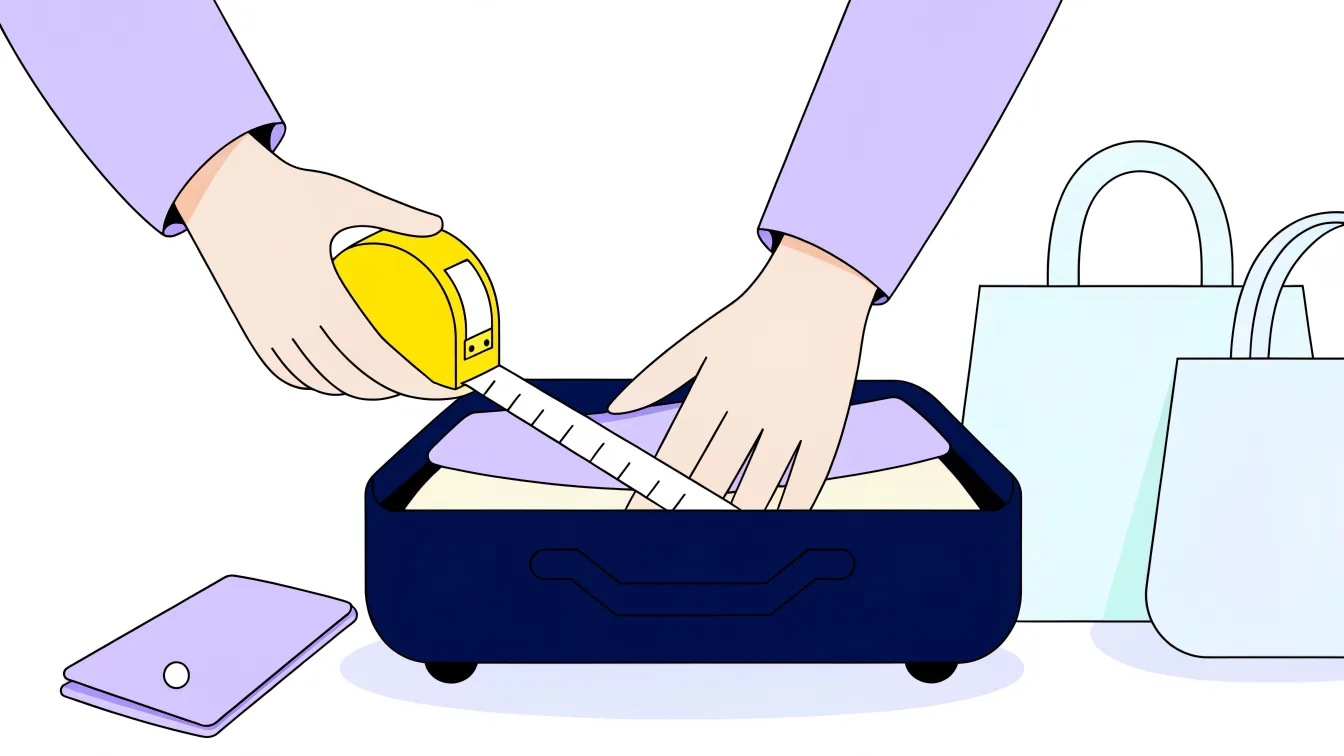
Samsonite says softside cases are typically lighter to lift, but check the two actual cases before assigning a weight advantage. Write down each empty weight beside its full exterior size. A smaller case is not a fair weight comparison with a larger one merely because both use the same carry-on label.
Example: a 6 lb case and an 8 lb case, each packed with 15 lb of clothes, weigh 21 lb and 23 lb. That 2 lb gap follows you through every lift.
Expansion deserves the same treatment. Record closed and expanded dimensions separately. If the maker lists no expanded size, you cannot judge airline fit once the bag is expanded.
For American Airlines, compare the loaded exterior with its 22 x 14 x 9-inch standard allowance and sizer requirement. Checked November 5, 2026; reconfirm for your itinerary.
Expansion is fine for a road trip or a checked bag. The mistake is assuming the expanded case still counts as a carry-on. Review airline baggage rules before building your shortlist.
Repair support can settle a close decision
Ask what happens if a wheel fails, a handle jams or the main closure stops working. Before buying, ask how the process works, which parts are stocked, who pays shipping and what the coverage says for that exact model.
The distinction between defects and travel damage matters. For example, Travelpro's general limited-warranty page excludes normal wear and various handling damage. That page is not a substitute for checking a particular collection's separate coverage.
Likewise, do not interpret a long warranty as a promise that a suitcase cannot fail. A warranty describes a remedy under stated conditions. It does not measure the probability of damage on your next trip.
A practical request to customer service is: “Can this wheel assembly be replaced, and what would I need to send you?” Add the exact model identifier. Ask the equivalent question about the shell or fabric panel if repairability is central to your choice.
Compare the answers, not just the headline duration. A repair route you understand is more useful than a vague expectation of lifetime service.
When shell type matters less
For a trip carrying ordinary clothing, the hard-shell vs soft-sided luggage choice may matter less than you expect. Concentrate on size, the way it opens, the handle position and how easily you can lift the packed case.
Use this final comparison before ordering:
- Confirm both candidates meet your required loaded exterior size.
- Compare empty weight at a similar useful capacity.
- Trace how you will reach the items needed during travel.
- Check the opening against your likely room layout.
- Read the exact repair and warranty terms.
If both options still work, choose the arrangement you prefer packing. The hard-shell carry-on guide can help turn that preference into a model shortlist.

FAQ
Is hard-shell luggage always lighter?
No. A category label does not tell you what a particular case weighs. Compare published empty weights for similarly sized bags, then add your expected contents.
Compare cases of the same full exterior size, including handles and wheels.
Can soft-sided luggage squeeze into an airline sizer?
Only judge the bag as packed. Flexible fabric does not mean every part of the case can compress.
American Airlines requires the carry-on to fit its sizer. Measure the widest loaded points, including pockets, wheels and handles, then reconfirm the operating airline's requirements before departure.
Is a hard shell enough to protect fragile items?
Do not assume so. A rigid shell and flexible fabric provide different exterior structures, but that distinction is not a protection rating for your object.
Check its packing requirements separately. A broad protection claim on a product page is not a reason to buy.
Which type is easier to repair?
Ask about the specific failure and exact model. Wheel replacement, a damaged panel and a broken closure are different jobs.
Warranty terms may exclude wear or handling damage, so confirm coverage as well as repair availability. Neither shell category guarantees an inexpensive repair or available replacement parts.
Related guides

Spinner vs two-wheel luggage: which rolls better for you?

Travel backpack vs suitcase: which suits your trip?

Laptop backpack vs messenger bag vs briefcase

Rolling backpack vs regular backpack for school

Gym duffel vs gym backpack: which is easier to live with?