Bag fabric denier explained
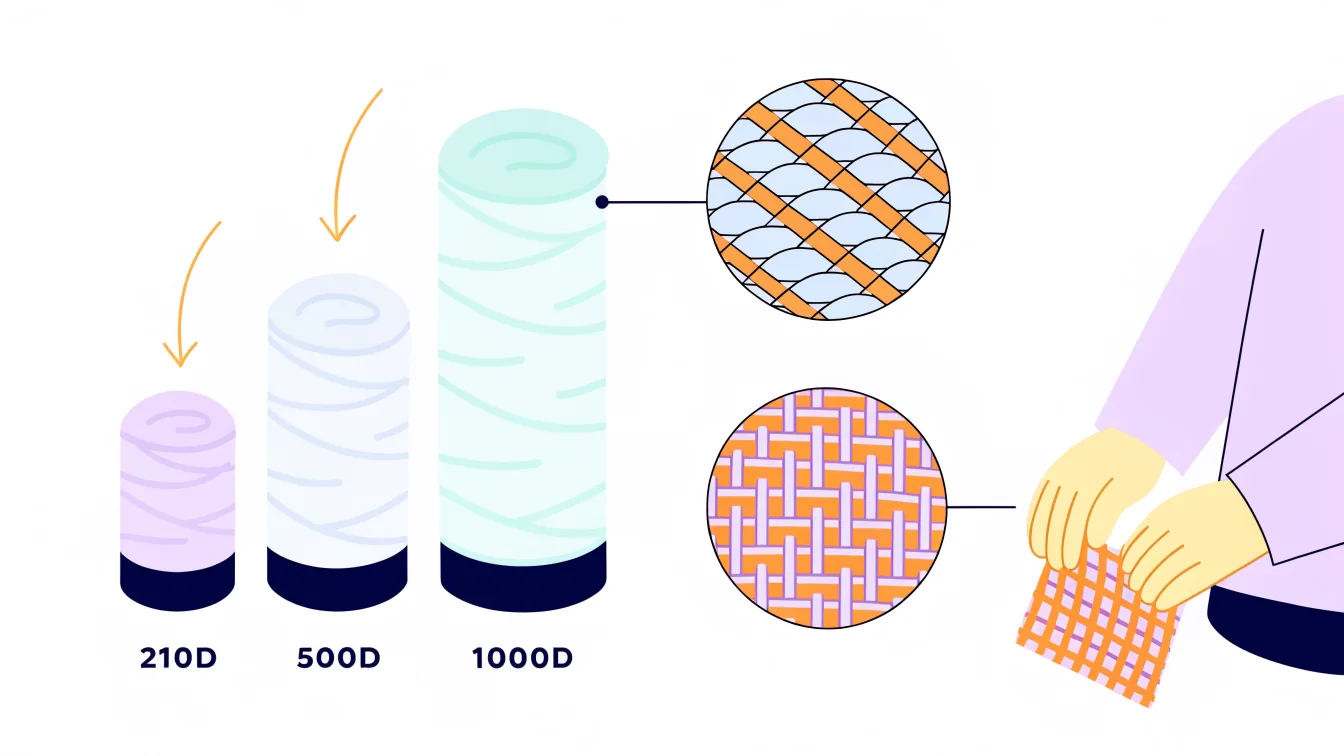
What is denier? It is the mass of a yarn relative to its length: a 500D yarn weighs 500 grams per 9,000 meters. Higher numbers describe heavier yarn, not automatically stronger fabric; fiber type, weave, coatings, and construction matter just as much.
What is denier? The D after a fabric number
The D means denier. It is a unit of linear density: how much a measured length of yarn weighs. The QUDT units vocabulary defines it as the mass in grams per 9,000 meters.
So a 210D and a 600D label do not tell you how thick the completed bag will be. They refer to the yarn used.
A finished fabric includes many yarns crossing one another, plus any coatings, laminates, backings, or reinforcement. Those additions can change the finished fabric's weight and performance.
The number is useful because it offers a quick clue about the yarn. Comparing two otherwise similar weaves made from the same fiber, a larger denier often points to a heavier yarn. But it is not a replacement for a published fabric-weight figure or abrasion test.
When a listing says only “premium 900D,” ask what fiber it describes and whether the number applies to the outer shell, bottom panel, or lining. A bag can contain several different fabrics, each doing a different job.
210D vs 500D vs 1000D: a practical reading guide
| Label | Yarn mass over 9,000 m | Practical question to ask |
|---|---|---|
| 70D | 70 g | Is this a lightweight liner or shell, and how is it supported? |
| 210D | 210 g | What weave and coating are used? |
| 420D | 420 g | Is it the main fabric or only the bottom panel? |
| 500D | 500 g | What is the published abrasion or tear performance? |
| 1000D | 1,000 g | Does the extra fabric mass help this bag's actual use? |
These masses follow the denier definition; they are not finished bag weights. The table is a reading aid, not a durability ranking.
A lightweight travel sack might prioritize a compact packed size. A tool tote might prioritize stiff, abrasion-resistant panels. That difference can justify very different fabrics without making either choice inherently wrong.
For a real example, CORDURA Classic fabrics run from 330D to 1000D, all made from high-tenacity nylon 6,6. The product description also discusses abrasion resistance, tearing, and finish options.
Why a larger denier number is not always better
Imagine two backpacks. One is advertised as 1000D polyester. Another uses 500D nylon.
Which will last longer? Their denier labels alone cannot answer. They use different fibers and may use different yarn quality, weave density, or surface treatments.
Even within nylon, basket weave, plain weave, and ripstop behave differently. A densely woven cloth may resist abrasion well, while a ripstop grid is built to stop a tear from spreading.
Coatings can help with moisture but may change stiffness or eventually wear. A stiff fabric can also make a compact bag less comfortable to pack.
A useful manufacturer's materials page identifies multiple separate variables. One bag maker's ballistic nylon description, for instance, specifies a basket weave, coating, and fabric weight. That is more informative than a bare denier number.
Thick fabric does not save weak stitching either. A strong panel may survive years of rubbing while a poorly reinforced strap attachment fails early.
Look at the entire bag: stress points, seam design, zippers, and bottom reinforcement. See the bag construction hub for other inspection points.
What matters besides denier?
| Specification | Why it matters | What to look for |
|---|---|---|
| Fiber | Influences feel, stretch and abrasion behavior | Nylon, polyester or another stated composition |
| Weave | Influences structure and tearing behavior | Plain, basket, ripstop or other named construction |
| Fabric weight | Shows mass per area rather than per yarn length | oz/yd² or g/m² |
| Surface finish | Influences water shedding and hand feel | Coating, laminate or water-repellent treatment |
| Abrasion testing | Offers a defined performance comparison | Test method and results for comparable samples |
| Seam construction | Controls how panels join under load | Reinforcement at handles, straps and corners |
An abrasion number is useful only with its test conditions. Different test methods, pressures, and materials can produce results that should not be compared casually. A vague claim like “five times tougher” requires a documented baseline.
Fabric composition also matters for care. Some coatings cannot tolerate heat or aggressive cleaning. Follow the bag manufacturer's instructions rather than assuming all 500D fabrics clean the same way.
What denier means when you shop
Start with the job. For a packable grocery backup, prioritize size and folded bulk.
For a commuter pack, consider weight, back comfort, and weather protection together. For a rugged gear hauler, reinforced corners and fabric information may deserve more attention.
Then separate known facts from advertising adjectives. A transparent product page identifies the shell material, denier where relevant, lining, zippers, hardware, and warranty.
The maker may also give the pack's total empty weight. That final number helps you judge whether a tougher-looking fabric adds a weight penalty.
Compare bags using the same kind of information. For how the three fabrics shoppers most often weigh stack up, see ballistic nylon vs Cordura vs polyester.
If one listing names 420D and another names only “durable canvas,” that is not enough for a fair strength comparison. Ask for materials and construction details rather than awarding the higher number an automatic win.
If your main concern is rain, denier is the wrong first filter. Look for coated seams, closure details, and water-protection claims in the waterproof versus water-resistant guide. A heavy textile can still leak through zipper gaps.
Three common denier myths
Myth: 1000D is twice as strong as 500D. The measurement doubles yarn mass per unit length, not tensile strength or abrasion performance. Tests would be needed to compare those properties.
Myth: Higher denier always means a heavier bag. It can contribute to weight, but fabric area, coatings, padding, hardware, frame, and pockets affect the bag's total mass.
Myth: Denier tells you whether the bag is waterproof. It does not. Water protection depends on the full construction, especially coatings, seams, and closures.

FAQ
Is 600D polyester good for a backpack?
It may be suitable for an everyday bag, but 600D alone is insufficient for a durability verdict. Inspect the weave, backing, zipper construction, and strap attachments. The polyester's actual performance depends on more than the yarn's linear density.
Is 1000D nylon better than 500D nylon?
Not automatically. If both fabrics otherwise share composition and construction, their heavier yarns may influence weight and structure. But water treatment, abrasion results, and how the backpack is assembled can change the practical outcome.
What does 420D ripstop mean?
The 420D refers to yarn linear density. Ripstop names a fabric construction designed to help limit tear propagation. Together they describe two different aspects of a fabric, not a standardized bag-quality rating.
Does higher denier make a bag waterproof?
No. A tightly woven fabric may shed some water, but leakage can occur at seams and openings. For wet conditions, examine the maker's water-protection specifications and closure instructions rather than relying on the D label.
Is denier the same as fabric thickness?
No. Denier measures mass per yarn length. Finished thickness also depends on how many yarns are used, how they are woven, and whether the fabric has backing or coating. Compare actual fabric-weight and construction information if offered.