Hat boxes and hat bags
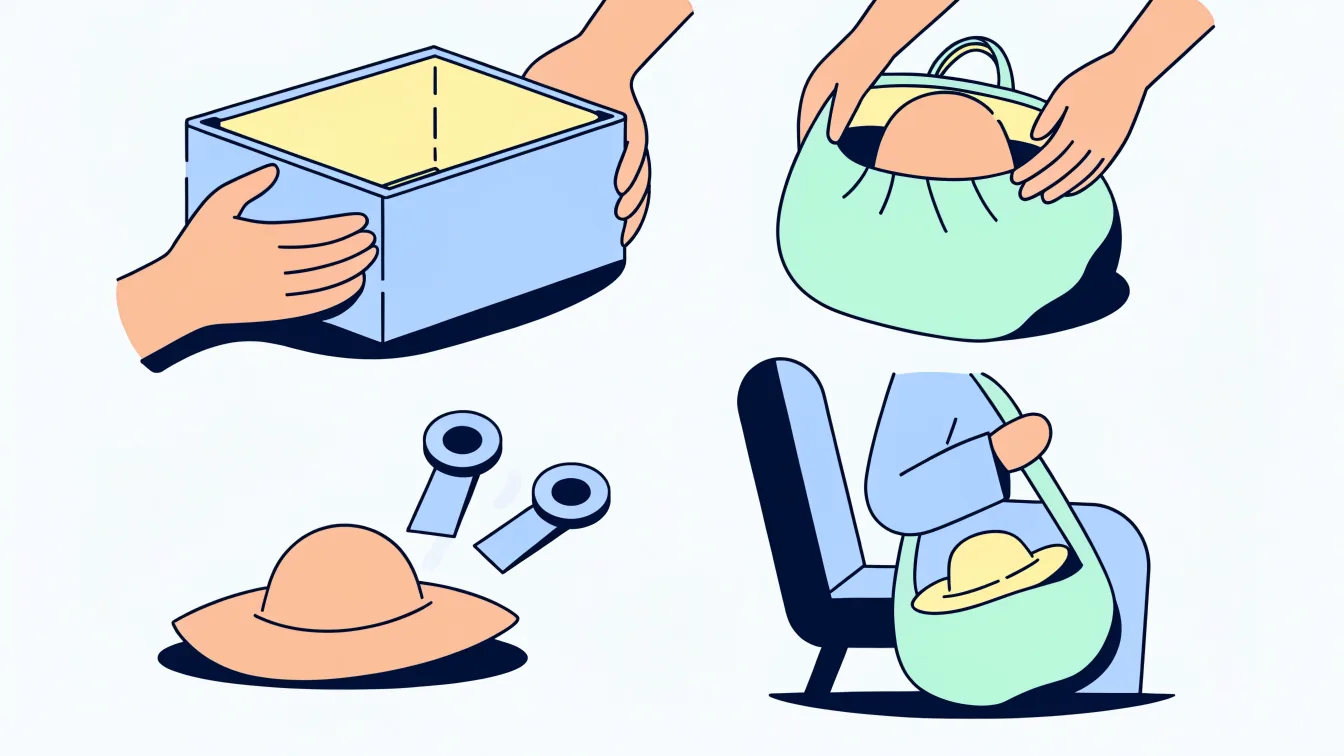
A hat box for travel should fit your hat's complete brim, crown and trim without forcing its shape. Start with usable interior dimensions; one case maker explicitly labels its sizes as internal. Then choose the enclosure and carrying method around your journey.
Which hat carrier suits your journey?
Choose the carrier around how you plan to move and store the hat. For a direct car journey, start with the available space and the hat's support needs. For flying, consider the baggage allowance before selecting a case.
Separate enclosure, structure and attachment in your comparison. They answer different questions: what surrounds the hat, what holds the carrier's shape, and how you carry it.
| Carrier type | Published construction or function | Question to resolve |
|---|---|---|
| Lidded case | Removable lid with strap-and-buckle closure; maker details | What are the usable interior and complete exterior dimensions? |
| Carton box | A carton intended for hat shipping; maker details | Is this intended as packaging, storage or travel luggage? |
| Padded soft bag | Canvas shell with removable sidewalls; maker details | What structure remains when assembled? |
| Simple hat bag | A bag with a dedicated crown pocket; maker details | How is the hat supported during your journey? |
| Exterior clip | Magnetic brim attachment to a bag or belt; maker details | Can you manage the exposed hat along the route? |
Start with the least complicated arrangement that meets your specific needs. Add a shoulder strap, luggage sleeve or accessory pocket only when it solves a carrying problem.
The broader travel-accessories guide helps you plan those extras around the rest of your luggage.
How to measure a hat box for travel
Measure the hat as you intend to transport it. Include any fixed trim, raised brim edges or decoration that must retain its position.
Use this sequence to make a fitting record:
- Place the hat in the position recommended by its maker for storage.
- Measure its longest span from one outer brim edge to the opposite edge.
- Measure across the brim in the other direction.
- Record its full height, including any trim projecting above the crown.
- Compare the outline with the case's usable interior and support arrangement.
Do not substitute the head-size label for these measurements. Record the complete packed shape instead, then keep that outline beside the case specifications.
For example, Hattin' Around publishes internal sizes of 13 inches across by 7 inches deep and 15 inches across by 9 inches deep. Maker's dimensional definitions.
As a hypothetical example, reject a 13-inch clear interior for a rigid hat spanning 14 inches. That comparison does not include any additional support or trim clearance.
Avoid prescribing one universal clearance allowance. Use the hat's support requirements and the case maker's fitting instructions. Our bag-measuring guide explains the distinction between internal space and exterior size.
Compare rigid boxes and soft bags by their actual construction
For a rigid box, look for a clear description of the shell and supporting insert. For a soft bag, establish which panels are padded and which parts maintain the assembled shape.
Avoid assuming that every round case is rigid. Gigi Pip describes its example as a softshell bag, with coated-polyester tarpaulin outside and polyester lining inside. Published construction.
A different example uses washed cotton canvas, polyester lining and removable sidewalls. Its listed dimensions change from 17.5 x 17.5 x 8 inches assembled to 3.5 inches high collapsed. Maker's specifications.
| Detail | Why to examine it | Decision to make |
|---|---|---|
| Assembled structure | Storage photographs may show a different configuration | Compare the case ready for use |
| Hat support | An empty cavity tells only part of the fit story | Match the support to your hat |
| Closure | Lid and zipper arrangements differ | Choose access you can manage while traveling |
| Packed exterior | Straps and handles need accounting for | Record the complete carried size |
For scale, a simple hat bag publishes a 17-inch width, 16-inch height and a pocket accommodating a 6-inch crown. Maker's dimensions.
Use specifications like these to ask precise fitting questions. Shape, material and dimensions belong together in the decision.
Choose a box, clip or suitcase-packing method
Use a separate case when your plan calls for an enclosed carrier fitted around the hat. Consider a clip when your priority is carrying it outside another bag between uses.
Klipsta describes a magnetic clip that holds the brim and attaches to bag handles, backpack straps or belts. Its instructions specify brim placement between the magnets. Maker's attachment instructions.
For any clip, follow its fitting instructions and consider where the exposed hat will sit when you put the bag down. Plan around doors, seating and the other luggage you need to handle.
For suitcase packing, start with the exact hat's instructions. American Hat Makers distinguishes its crushable styles from other packable designs. It warns that certain packed styles may not regain their original perfect shape. Maker's packing guidance.
Do not apply one hat's folding instructions to an unrelated model. If preserving the existing shape is essential, choose your packing method around that requirement.
Before departure, rehearse the complete arrangement. Set down the luggage, reach for the hat and return it to its carrier. Revise anything that requires awkward handling.
Keep the case's intended role clear too. A box supplied for shipping may suit a different task from a bag designed to be carried repeatedly. Example of carton hat packaging.
Flying with a hat case: dimensions come first

A maker's travel description does not establish an airline allowance. Use the operating airline's current policy and the case's complete exterior measurements together.
American Airlines allows one personal item and one carry-on meeting its requirements. Its personal-item limit is 18 x 14 x 8 inches (45 x 35 x 20 centimeters). The carry-on limit is 22 x 14 x 9 inches. Official requirements, checked November 2026.
The carry-on metric equivalent is 56 x 36 x 23 centimeters, including handles and wheels. The airline also requires the bag to fit its sizer. Official carry-on policy, checked November 2026.
For a practical comparison, Two Roads lists its assembled case at 17.5 x 17.5 x 8 inches. Compared directly, its second 17.5-inch side exceeds American's 14-inch limit. Case dimensions; airline dimensions.
That is a dimensional comparison, not a prediction about a particular gate decision. Avoid planning around an exception.
For your itinerary, record the operator, permitted item count and dimensions before choosing a separate carrier. Plan how the hat travels if that arrangement cannot be accepted.
Rules change. Confirm with the operator before departure, and use the airline-baggage guide to organize the rest of your luggage plan.
Pack around the brim, crown and trim
Begin with the hat maker's storage position. Stetson advises storing its felt and straw hats upside down on their crowns, on a clean surface or in a hat box. Maker's care guidance.
Use any supplied support according to its instructions. Before closing the carrier, look at where the hat touches the interior and where its trim sits.
For multiple hats, treat the proposed stack as a new fitting exercise. Gigi Pip lists space for two or three hats depending on crown height. Published capacity qualification.
Plan the packing order rather than relying on a hat-count label:
| Packing stage | Action | Decision before continuing |
|---|---|---|
| Position the first hat | Follow its care and support instructions | Does it sit as intended? |
| Add another hat | Examine the combined shape | Can both retain the required position? |
| Store accessories | Use separate designated space | Is anything pressing against the hats? |
| Close the carrier | Follow its fastening instructions | Does closure require forcing the contents? |
If the arrangement fails, reduce the load or change the carrier. Avoid using the lid as a packing tool.
For a formal or decorated hat, prioritize its individual support instructions over general packing shortcuts. Plan the return journey with the same care as the outward trip.
Care, storage and mistakes to avoid
Use separate instructions for the hat and its carrier. A bag's exterior material does not tell you how to clean the headwear inside.
Stetson advises keeping its felt and straw hats away from sources of heat, including enclosed cars in summer. Its wet-felt guidance calls for natural drying away from heat. Maker's care instructions.
For the carrier, read any water-protection claim narrowly. Hattin' Around describes its cases as water-resistant and explicitly says they are not waterproof. Maker's limitation.
Common planning mistakes include choosing by head size alone, comparing internal measurements with airline limits, and assuming a collapsed bag can travel that way with hats inside.
Another mistake is leaving the case choice until the rest of your luggage is full. Decide early whether the hat needs a separate carrier, and assign that carrier a place in your transport plan.
For home storage, keep the fitting notes with the case so you can repeat the arrangement next time. Photograph the supported position if it will help you repack accurately.
Choose a hat box for travel around the hat you actually own. The useful specification is the one that explains your hat's fit and your journey's requirements.

FAQ
Does a hat box count as a carry-on?
Plan for it within the operating airline's item allowance unless the airline confirms an exception. American's policy allows one compliant personal item and one compliant carry-on. A maker's description does not settle acceptance for your itinerary. Compare the complete case with current requirements before traveling. Official policy, checked November 2026.
What size box do I need for a wide-brim hat?
Measure the hat's entire brim in both directions, its full height and any projecting trim. Compare those measurements with usable internal space and the support arrangement. Case labels can describe different dimensions; one maker expressly identifies its published sizes as internal. Dimensional guidance.
Can I put more than one hat in a travel case?
Use the case maker's guidance and the hats' individual support requirements. One published case accommodates two or three hats depending on crown height. Treat that qualification as part of the specification. Examine the combined shape before closing, rather than assuming a stated count fits every combination. Maker's capacity description.
Can I fold a hat instead of using a box?
Follow the exact hat's packing instructions. American Hat Makers identifies particular crushable and packable styles, with different handling guidance. It also warns that some packed styles may not return to their original perfect shape. Avoid transferring those instructions to a hat with different construction or care requirements. Maker's guidance.
Related guides
- Trunks and travel chests: planning larger containers around storage and transport.
- Packing guides: organizing the rest of your luggage around protected items.
Sources
- hattin-around.com/hat-cases-the-better-hat-box
- magillhats.com/product/hat-box
- tworoadshatco.com/products/travel-hat-case-charcoal
- gigipip.com/products/hat-travel-case
- americanhatmakers.com/products/ahm-hat-bag
- klipsta.com/products/hat-clip
- stetson.com/pages/frequently-asked-questions
- americanhatmakers.com/pages/faq
- aa.com/web/i18n/travel-info/baggage/carry-on-baggage.html