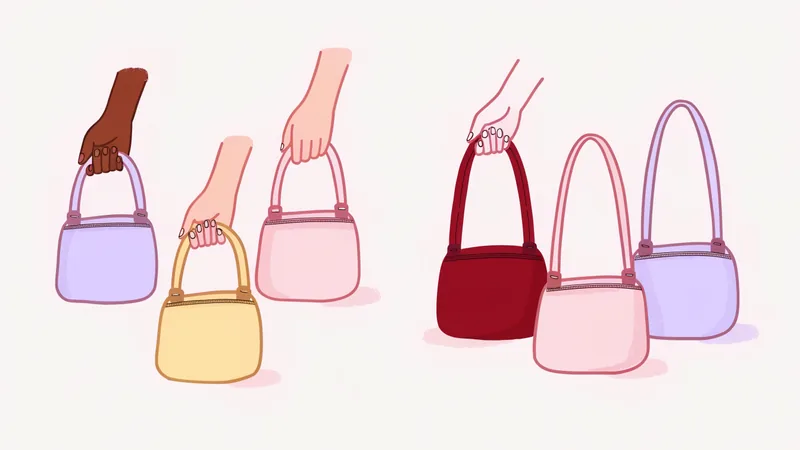
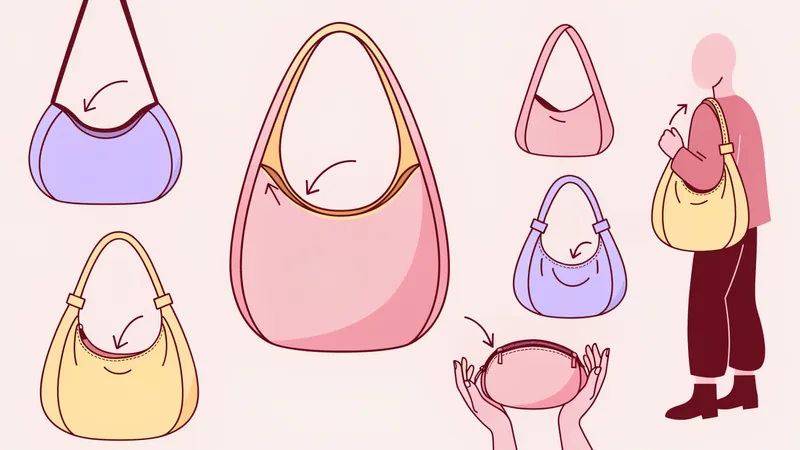
The history of the handbag

The history of the handbag follows changes in clothing, access, decoration, and carrying methods, rather than one inventor's breakthrough. Museum collections show concealed pockets alongside visible purses, then designs that combined portable storage with new ways to wear an accessory.
A timeline of the history of the handbag
The timeline describes documented examples, not moments when everybody changed bags. A surviving purse establishes that a design existed; it does not identify its first maker.
| Date | What happened | Source |
|---|---|---|
| By about 1650 | Tie-on pockets were in common use in European women's dress. | V&A |
| 1795–1800 | A French silk reticule survives from this period | The Met |
| About 1800 | A reticule is fashioned from an earlier man's waistcoat | Museum at FIT |
| 1800–1810 | A silk-and-metal reticule is cataloged as probably German | The Met |
| First quarter, 19th century | A British knitted reticule retains its ribbon trim | The Met |
| About 1930 | A Cartier clutch combines textile work with ornamental hard materials | Museum at FIT |
| February 1955 | Chanel introduces the 2.55 | V&A |
| 2002 | Mary Ping creates the Ultimate bag from a canvas tote. | Museum at FIT |
Notice the overlapping early dates. They show different objects in circulation, rather than a procession in which one national style replaced another.
This history concentrates on European and American fashion collections. It is one branch of the broader history of bags, not an account of every carrying tradition worldwide.
Concealed pockets already provided portable personal storage
The V&A describes separate pockets tied around the waist, reached through openings in dresses and petticoats. They could be worn singly or in groups. Pocket construction.
That arrangement complicates a familiar assumption: a separate bag did not have to be displayed outside clothing to be useful.
The museum also records their continued use alongside other bags and pockets. V&A account. A change in fashion therefore should not be imagined as an overnight replacement of everyone's belongings.
Compare the arrangements as designs. One container is hidden beneath an outfit; another hangs from a hand or wrist. The placement affects how it participates in the visible silhouette.
The important distinction is between storage and display. A concealed accessory could provide the first without being intended to provide the second.
Avoid treating pockets as evidence that their wearers lacked interest in decoration. The V&A's surviving examples include embroidered designs. Collection examples.
For the relationship between clothing construction and access, continue with pockets and handbags. That relationship deserves its own account, without turning historical clothing choices into assumptions about people today.
Reticules brought a small container into view
FIT connects the rise of narrow early-19th-century silhouettes with small wrist-carried reticules. Its exhibition includes one made from an earlier embroidered waistcoat. Reticule interpretation.
That object is particularly revealing because it crosses categories. Material from a garment became a separate accessory while retaining evidence of its previous form.
The Met's British example presents another approach. It is knitted into a lantern-like shape and retains its original ribbon trim. The museum dates it to the first quarter of the 19th century. Object account.
These details make the reticule more than a placeholder between pockets and modern bags. Shape, textile technique, and trimming contributed to the finished object.
The French example dated slightly earlier is cataloged simply as silk. French reticule. Its record supplies a date range and material without naming a designer.
Read those records together as evidence of variety. They do not justify inventing a single moment when every woman began carrying an external bag.
Nor should the small scale become a criticism of its wearer. A collection object can be studied for its intended role without requiring it to perform a modern commute.
Materials and ornament created several kinds of handbag

The Met catalogs a reticule from 1800–1810 in silk and metal, identifying its cultural origin as probably German. Museum record.
Preserve that word probably. It distinguishes an attribution from a confirmed place of manufacture and prevents a tentative record becoming a certainty through repetition.
For comparison, the later Cartier clutch displayed by FIT combines wool needlepoint and suede with jade and rock crystal. Material description.
These examples suggest a useful way to examine historical handbags. Separate the material forming the container from its opening, fastening, handle, and applied decoration.
A material list alone does not explain how an object was worn or how much it held. It identifies components that need to be understood in relation to the design.
The comparison also avoids a simple narrative of textiles giving way permanently to leather. The dated objects include combinations rather than a single inevitable material progression.
When examining a museum photograph, look for the relationship between opening and ornament. A closure can be part of the visual design as well as a way of holding the container shut.
Shoulder carrying added another relationship with dress
The V&A describes the original 2.55 with a flap, rectangular turn lock, quilting, and an adjustable metal strap. Eyelets allowed hand or shoulder carrying. Design history.
That account gives a concrete explanation of the design's practical significance. The carrying method could change without requiring the owner to select a different container.
It does not establish that Chanel invented all shoulder bags. A documented launch concerns this particular design, rather than every previous use of a strap.
The same distinction applies to familiar names. A bag's place in fashion history may involve a recognizable combination of details rather than the invention of every individual component.
For a wider discussion of documented designs, see iconic bags. Keep the cultural account separate from deciding what you personally want to carry.
A historical shoulder strap tells us about one design's arrangement. It cannot establish the fit, comfort, or suitability of a present-day version for a particular wearer.
Use the archive to understand the idea, then use an actual item's specification to investigate its measurements, opening, and carrying options.
Reading handbag history through objects
The history of the handbag becomes clearer when several questions remain separate. When was this object made? What is it made from? How was it carried?
Add two more questions when the evidence allows them: what did it contain, and what meaning did its maker or wearer give it?
Hampshire Cultural Trust's overview connects bags with valuables, grooming items, correspondence, and activities such as needlework. Museum interpretation. That variety is a reminder to consider function alongside appearance.
However, do not assign all those contents to every surviving purse. An institution's broad account describes possibilities across a collection, not the inventory of each object.
On her 2002 Ultimate bag, Mary Ping gave a plain canvas tote a chain, quilting, and a bamboo handle. The tote kept its everyday shape, while its details recalled the status bags of Chanel and Gucci.
This approach leaves room for overlap: a pocket, reticule, clutch, and shoulder bag can be compared without declaring one the final improvement.
For an individual vintage piece, investigate its identity and condition separately. The guide to buying secondhand bags organizes those questions without turning a historical resemblance into proof of authenticity.

FAQ
Who invented the handbag?
The records here do not identify one inventor of the entire category. They document several ways of carrying personal belongings. The V&A's pocket history and the Met's reticules describe overlapping forms. A named designer's later launch is a specific milestone, rather than evidence that no earlier handheld bag existed.
What is a reticule?
In these fashion collections, the term describes a small personal bag associated with late-18th- and early-19th-century dress. FIT discusses wrist carrying, while the Met's British example is knitted and retains ribbon trim. Read the individual record for its date, construction, and attribution instead of assuming every reticule looked identical.
Did handbags immediately replace pockets?
The V&A notes that tie-on pockets remained popular even when other bags were available. That supports an account of coexistence rather than instant replacement. Clothing silhouette helps explain some changes, but it does not provide a universal timetable for all wearers or regions.
Did Chanel invent the shoulder bag?
The V&A records the 2.55's launch and its particular strap arrangement. That evidence establishes a design milestone, not the invention of every shoulder-carried container. Distinguish a named bag's recognizable combination of features from a claim that each feature appeared for the first time on that bag.
Sources
- vam.ac.uk/articles/womens-tie-pockets
- metmuseum.org/art/collection/search/116948
- exhibitions.fitnyc.edu/pockets-to-purses
- vam.ac.uk/articles/what-makes-chanel-so-iconic
- metmuseum.org/art/collection/search/156853
- metmuseum.org/art/collection/search/156995
- collections.hampshireculture.org.uk/topic/brief-history-bags-and-purses