Chef knife bags and rolls
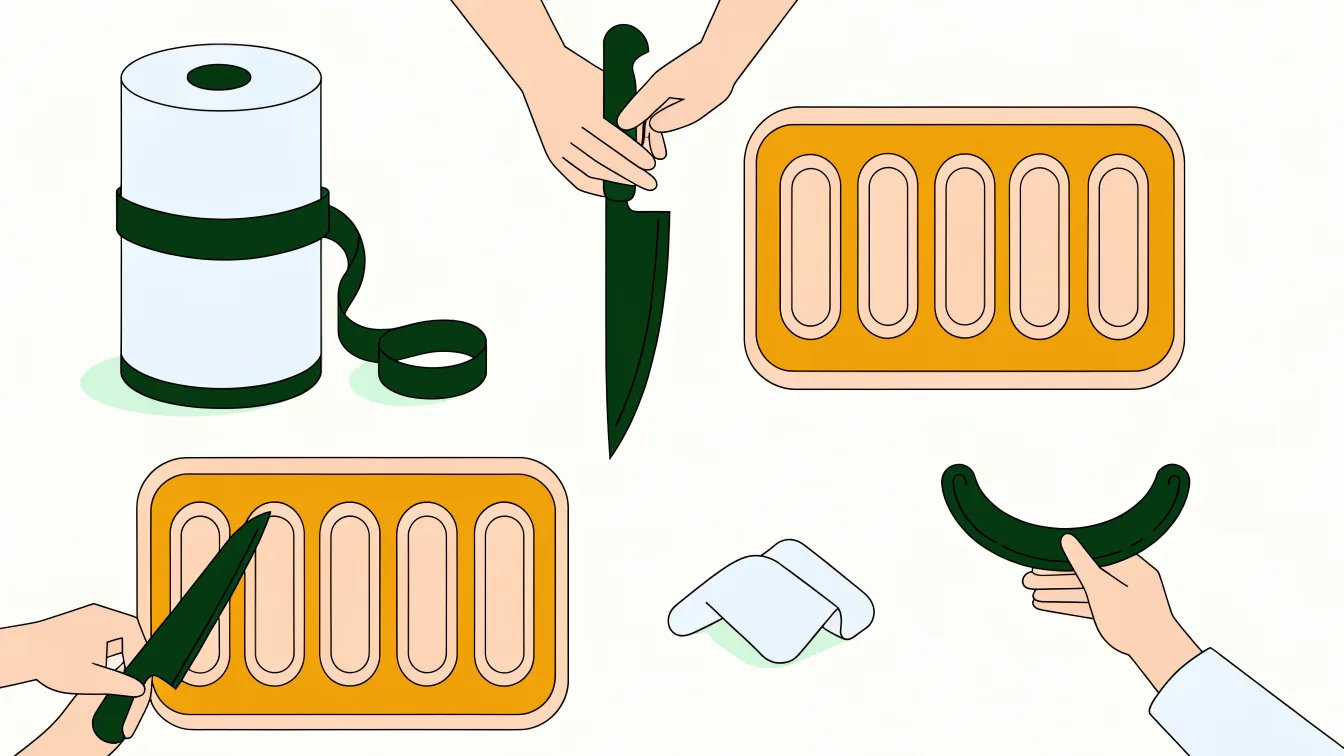
A chef knife bag organizes culinary tools for transport. Choose it around each guarded tool's full length and width, then compare slots, closures, and cleaning instructions. A pocket count alone cannot tell you whether your particular kit fits.
Which chef knife bag format suits your kit?
Choose the format around your tools and the space available for unpacking. Begin with the knives you actually carry, then add the supporting tools.
Published constructions include an elastic-pocket roll with a hook-and-loop closure and a zipped case with additional fastening straps. Roll construction, case construction
Use the following table as a selection framework. Confirm the details on the exact model rather than applying one design's features to every bag.
| Format | Layout to examine | Suits a shortlist built around | Main fit question |
|---|---|---|---|
| Folding or rolling carrier | Individual tool pockets and cover flap | A defined everyday kit | Can it close with every guard fitted? |
| Zipped knife case | Tool retention and separate compartments | Knives plus accessory storage | Are tools retained inside the closed case? |
| Knife insert within another bag | Insert attachment and outer compartment | A combined work load | Does the protected insert fit completely? |
| Hard protective case | Interior retention and padding arrangement | Transport requiring documented case protection | What protection does the complete case specify? |
Do not treat the last two formats as interchangeable with a dedicated knife roll. Establish their intended use with the manufacturer.
The work bags guide covers broader carrying choices. For this job, prioritize tool accommodation and retention over the bag's appearance.
How many slots do you actually need?
Count tools individually, including anything that does not resemble a knife. Add your honing tool, shears, peeler, and other equipment to the inventory.
Then separate dedicated tool slots from accessory pockets. One published eight-slot design also includes card pockets, pen pockets, and a zipped mesh compartment. Pocket specification
Those extra pockets should not be counted as additional knife positions without the maker's instructions.
Here is a hypothetical seven-position allocation:
| Position | Planned item | Measurement to record | Fit decision |
|---|---|---|---|
| 1 | Guarded chef's knife | Full protected length and width | Dedicated suitable pocket |
| 2 | Guarded bread knife | Full protected length | Sufficient cover allowance |
| 3 | Guarded paring knife | Protected length and handle width | Retention appropriate to its size |
| 4 | Guarded boning knife | Full protected outline | Suitable pocket shape |
| 5 | Honing tool | Overall length and handle | Accommodation specified by maker |
| 6 | Closed shears in their cover | Full protected outline | Suitable retained position |
| 7 | Additional approved tool | Complete packed dimensions | Reserve for an actual need |
This is an inventory example, not a universal packing prescription. Move an item to separate suitable storage if its pocket is unsuitable.
Leave out tools you do not need. Do not solve a shortage of positions by placing multiple exposed blades in one pocket.
How do you measure knives against a roll or case?
Measure the protected tool, including its handle and guard. Record the longest overall dimension and the widest part that must enter the pocket.
For example, a hypothetical knife might have an 8-inch blade but measure 13 inches overall. Its guard could increase the packed outline further.
Comparing only the blade length would miss that difference.
Published closed measurements also describe the carrier, rather than automatically defining usable pocket length.
| Construction example | Published closed dimensions | Published material or layout | What still needs matching |
|---|---|---|---|
| Seven-pocket roll | 20.25 x 5 x 1.25 inches | 600D polyester; elastic pockets | Guarded tool dimensions |
| Eight-pocket roll | 20 x 6 x 1.5 inches | Foam core; lined interior | Each tool within its listed accommodation |
| Single-zip case | 21 x 10 x 1.25 inches | 600D polyester; internal zipped compartments | Retention layout and complete kit |
Sources: seven-pocket product specification, eight-pocket specification, single-zip product specification.
Ask for pocket measurements when the published information gives only the closed exterior. Include handles, guards, and closure clearance in the comparison.
Do not interpret a tool-length claim as a blade-length allowance. Keep the maker's wording with your measurements.
Which materials and closures matter?
Compare the shell, lining, tool pockets, and closure separately. Give each component a job rather than ranking bags by fabric name alone.
For instance, the published polyester case has internal zipped compartments, an exterior pocket, and two fastening straps with snap locks. Case construction
Use that information to plan where accessories belong and how you will close the carrier.
A padded roll example combines a foam core, lined interior, reinforced tool pockets, and carrying handles. Roll construction
Those descriptions do not establish puncture resistance or protection against crushing. Request a documented rating if that performance matters to your journey.
For the closure, assess the complete packed kit. The outer fastening should engage according to the instructions without forcing handles or tools against it.
For the interior, choose a layout that lets you identify the position of each item before removal. Keep small accessories in their intended compartments.
Avoid choosing by denier alone. Compare the complete construction and instructions for the particular carrier.
Why do blade guards remain important?
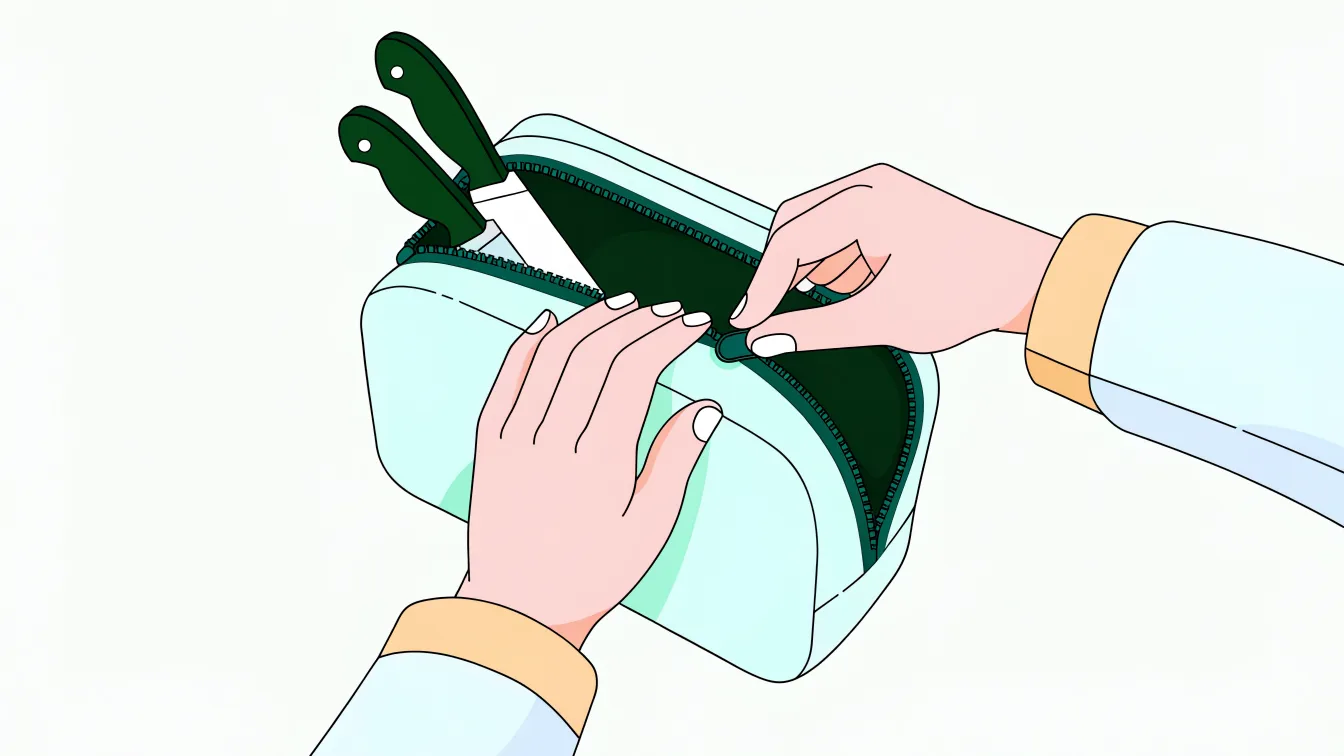
Treat the guard and carrier as parts of one packing arrangement. Follow the knife, guard, and bag instructions together.
The knife-luggage maker specifically recommends edge guards to protect fabric from cuts and blades from scratches. Knife-luggage instructions
Padding does not cancel that instruction. Neither does placing the roll inside another bag.
Choose a guard intended for the blade's dimensions and shape. Follow its fitting instructions, and measure the knife again with the guard installed.
Do not assume that every broad blade, pointed tip, or unusual handle will suit the same pocket. Request suitability information when the shape falls outside the examples shown.
For packing, use a clear workspace and account for every tool before closing the carrier. Keep the arrangement consistent between trips.
The Texas workplace safety guide emphasizes proper knife storage and careful cleaning. It also warns against submerging knives in soapy water. Kitchen safety guidance
These are general safety principles. Follow your kitchen's training and the equipment manuals for handling, cleaning, and storage.
If a pocket, guard, or fastening becomes damaged, resolve that problem before relying on the arrangement again.
How should you organize cleaning and daily packing?
Separate cleaning the tools from cleaning the carrier. Use the instructions for each, including the guards and any removable inserts.
One maker's cutlery guidance calls for hand washing, rinsing, and thorough drying before appropriate storage. Cutlery care
Its knife-case FAQ says the cases are not machine washable. Another knife-luggage instruction specifies a damp sponge and water only, without immersion. Case FAQ, luggage care
Use those as examples of why a universal washing routine is unsuitable.
Build your routine around a simple inventory: tools, guards, assigned positions, accessories, and closure. Count the tools before leaving and again when unpacking.
Place non-sharp accessories in suitable compartments rather than scattering them among knife positions. Keep identification on the carrier or designated label area.
Plan where the closed carrier will go during the commute and where it will be opened at work. Follow workplace procedures for storage and access.
For a contaminated or damaged carrier, obtain advice from its maker and your workplace before returning it to service.
What should you do before traveling with knives?
Check the rules for the actual carrier, route, and destination before packing. Do not assume that a work tool receives an exception.
Delta's security guidance directs travelers to leave sharp objects at home or place permitted items in checked baggage. Checked November 2026. Official airline guidance
That guidance is specific to the operator. Confirm acceptance and packing requirements with the airline you will use, including any connecting carrier.
Also review the rules at the destination and any workplace or venue you will enter. Avoid treating permission to check an item as permission to carry it everywhere afterward.
Keep the knife kit assigned to the appropriate luggage throughout packing. Recheck the contents of any bag intended for the cabin.
Use the relevant knife and guard instructions when preparing the kit. Follow the operator's requirements for the outer luggage as well.
Allow time to resolve questions before departure rather than at the checkpoint. Rules change, and an earlier trip does not establish acceptance for the next one.
This is general information, not legal advice. Keep the packing plan specific to your journey and the tools you intend to transport.
FAQ
Do I need a roll with more pockets than knives?
Count the complete tool kit before deciding. Include any honing tool, covered shears, and other equipment assigned to suitable positions. Keep card, pen, and mesh pockets separate from that count. One eight-slot design lists those accessory pockets in addition to its tool positions. Layout specification
Can I put knives in a chef knife bag without guards?
Follow the carrier's instructions. One knife-luggage maker explicitly calls for edge guards to protect the fabric and blades. Do not assume that padding or a zipped exterior replaces that requirement. Choose compatible guards first, then compare the complete protected tools with the pockets and closure. Care instructions
Can a knife roll go in hand luggage?
A bag's name does not establish permission for its contents. Delta directs sharp objects to checked baggage when permitted, or advises leaving them at home. Confirm the requirements for your own operator and route before packing. Keep the knife kit out of luggage intended for cabin screening. Airline security guidance, checked November 2026
Can I machine wash a knife case?
Use the instructions for the exact model. One knife-case maker answers no to machine washing. Another knife-luggage instruction specifies wiping with a damp sponge and water, without immersion. Remove the tools before approved cleaning, and obtain advice before using a method outside the instructions. Case FAQ, luggage care
Related guides
Sources
- mercerculinary.com/product/7-pocket-knife-roll-blue
- mercerculinary.com/product/single-zip-knife-case
- mercerculinary.com/faqs
- mercerculinary.com/use-and-care
- messermeister.com/products/preservation-black-knife-roll-8-pocket
- messermeister-europe.com/products/preservation-knife-luggage-collection
- tdi.texas.gov/pubs/videoresource/stpkitchen.pdf
- delta.com/us/en/check-in-security/airport-security