Tote vs backpack: which is better for every day?
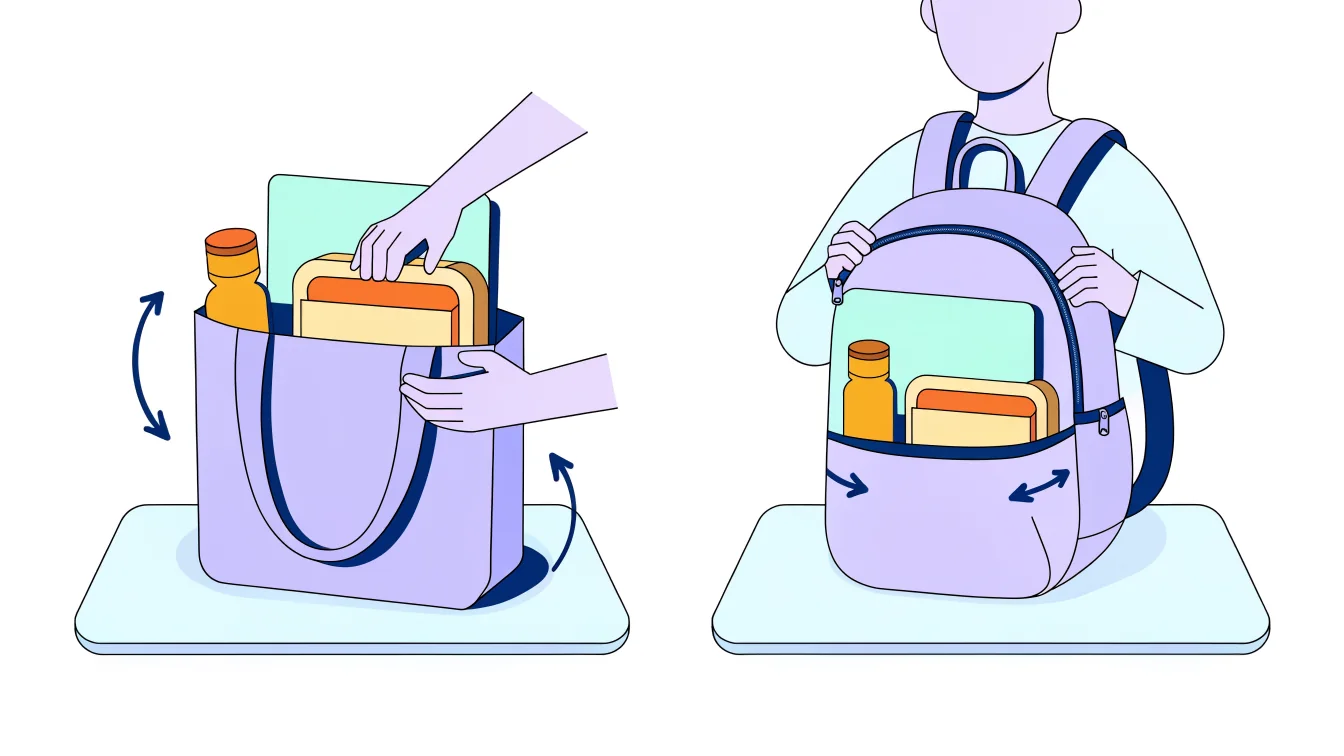
In the tote vs backpack decision, the backpack is usually the more practical everyday choice for heavier loads and longer walks. A tote is better for quick access, short trips and settings where you often set the bag down. Weight, route and closure decide it.
Tote vs backpack: the everyday comparison
| Attribute | Tote | Backpack | Practical verdict |
|---|---|---|---|
| Weight distribution | Usually one shoulder or hand | Usually both shoulders | Backpack for a longer or heavier carry |
| Access to contents | Reach from above while carried or set down | Usually needs turning or removal | Tote for frequent stops |
| Laptop protection | Depends on sleeve, base and closure | Depends on sleeve, base and padding | Neither wins without checking compartment details |
| Organization | Often one large compartment | Often multiple compartments | Backpack when many small items travel together |
| Crowded transit | Can tuck close at your side | Often needs removal in a crowd | Tote |
| Weather exposure | Open tops expose contents; zip options exist | Zippers and shells vary | Check fabric, seams and opening on either |
| Dress code | Easy to hand-carry into meetings | Reads casual unless work-styled | Tote for formal settings; either elsewhere |
| Packing flexibility | Broad opening accepts bulky objects | Structured compartments improve separation | Tote for awkward items; backpack for repeated kits |
The table describes common designs, not guarantees. Some totes have backpack straps, and some backpacks have a single spacious compartment. A carefully selected bag can erase several of these differences.
Choose a tote if quick access matters most
A tote shines when your route includes many small stops. Think of a walk from a parked car to a cafe, an office building or a neighborhood store.
The broad top opening lets you reach a wallet, a folded jacket or a notebook without searching behind your back. This is useful when the bag spends more time beside you than on your body.
For a tote to work well, make four checks. First, measure its base against what you carry every day. A narrow gusset may fit a thin notebook but not a lunch container beside a laptop.
Second, verify the shoulder strap drop over your normal clothing. Third, look for a reinforced base or internal sleeve if you carry fragile equipment. Fourth, choose a closure that matches your commute.
An open-top tote is convenient for an office where the bag moves from desk to meeting room. On an escalator or crowded bus, an open top can leave objects exposed.
A zip-top bag helps keep the contents in one place if you set the bag down awkwardly.
A tote is less convincing when the load becomes dense and you walk for a long time. Carrying a heavy object on one shoulder can feel lopsided; shifting sides may help but interrupts your walk.
Choose a backpack if your load or route is demanding
A backpack has an advantage when your daily route includes walking, cycling, transit connections, stairs or long periods without a place to set the bag down. Two shoulder straps make hands-free carry straightforward, leaving you able to manage a railing, bicycle lock or additional small purchase.
The American Academy of Orthopaedic Surgeons advises students to use both shoulder straps, adjust them to keep the load close to the back, and pack heavier things low and toward the center. That guidance is written for school backpacks, not adult work bags, so treat it as general guidance. The packing principle still applies: keep dense items close to your body. For ongoing back or shoulder pain, ask a doctor or physical therapist.
Next, choose the number of pockets based on daily objects. A separate area for a charger, notebook, keys and lunch can reduce clutter, but unnecessary partitions may make bulky objects harder to pack. For a simple load, one main area plus a secure small pocket may be plenty.
A backpack does have a drawback at crowded entrances and on transit. You may need to take it off to access tickets or avoid bumping others.
A front quick-access pocket helps, but security and courtesy still require attention. The extra adjustment time is the price of a more stable carry.
How much weight changes the answer
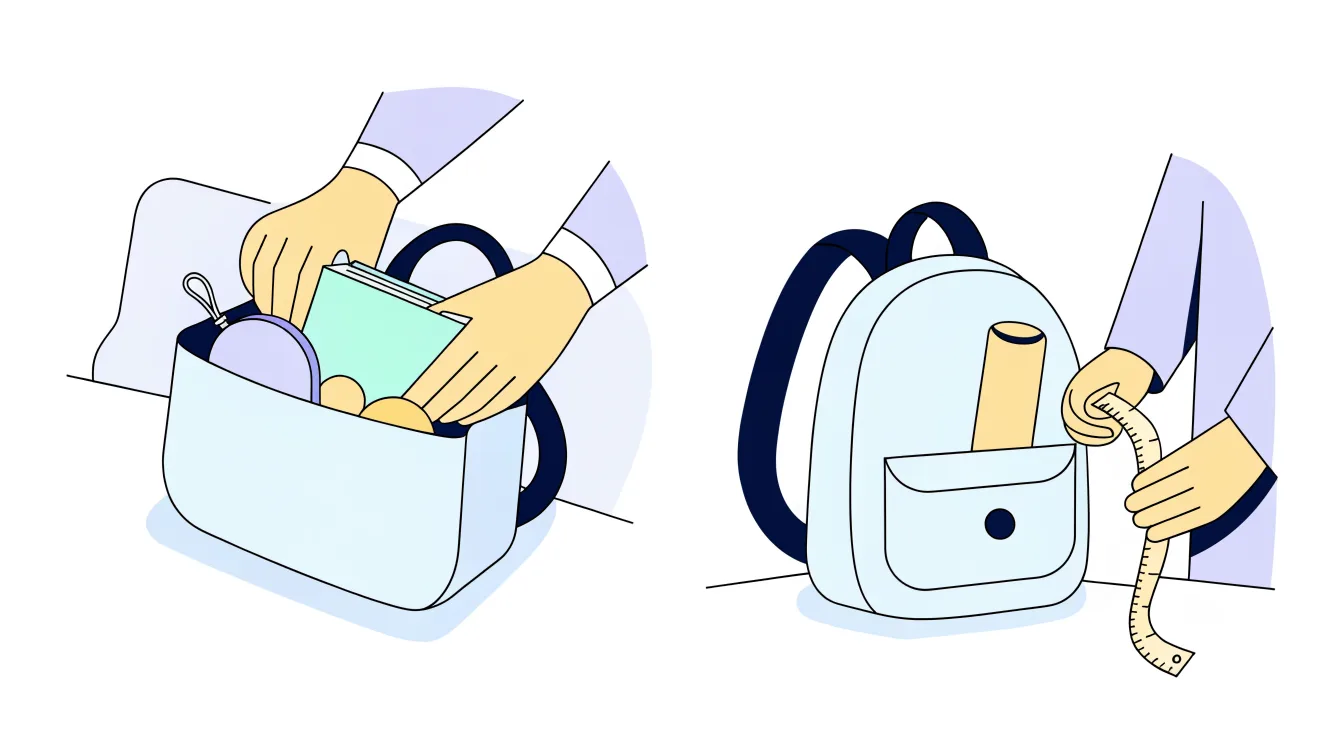
There is no universal cut-off at which a tote becomes unsuitable for every adult. Empty weight, strap width, distance carried, your preferences and the contents all matter. Instead of inventing a threshold, test with your actual daily kit: laptop, charger, filled bottle, lunch and outer layer.
Pack them in the candidate bag and wear it with your usual clothes and shoes. Walk your normal commute segment, climb a few steps, then reach for the item you use most. If a tote constantly slips or needs switching, a backpack may be better for that load.
Which style works for work, shopping and travel?
| Situation | Better pick | Why |
|---|---|---|
| Office and short meetings | Tote | Open access at a desk; add a laptop sleeve and full zip if it leaves the office |
| Transit and walking | Backpack | Keeps both hands free between stations; take it off on a packed train |
| Grocery stops | Tote | A broad opening takes odd-shaped goods; use a shopping carrier for a full load |
| Airport and weekends | Backpack | Easier through a terminal with tickets and a suitcase; a tote works as a secondary item |
Neither style guarantees airline personal-item acceptance: packed external dimensions and the carrier's rules control that.
When the difference barely matters
If you carry only a slim wallet, keys, headphones and a light notebook for a five-minute trip, either style may work well. Fit, closure, material and personal preference matter more than the two handles versus two shoulder straps. A tote with convertible backpack straps further narrows the difference.
The choice also matters less when the bag is mainly storage. Someone who drives directly to work and sets the bag under a desk needs different features from someone who walks across town. A rigid compartment or protective sleeve may matter more than how the bag hangs off the body.
Neither style wins on weather by default: check fabric, seams and closure on either.
A quick decision before buying
To settle tote vs backpack, choose a tote when you value immediate access, carry a light kit, and set the bag down often. Choose a backpack when you need two hands free, carry a heavier mix of items, or walk farther. For a mixed routine, look for a convertible style, but confirm that both carrying modes actually work for you.
Ready to pick one? See the best tote bags for everyday use or the best everyday backpacks. For more head-to-heads, see bag comparisons.
FAQ
Is a tote bag or backpack better for commuting?
A backpack is often easier for longer walks because it uses two shoulder straps and keeps hands free. A tote may be more convenient on short trips when you frequently access your wallet or notebook. For crowded public transportation, you may need to move either bag out of other passengers' way.
Are backpacks better for your back than tote bags?
Using both backpack straps spreads the carried load more evenly than holding a bag on one shoulder. The AAOS describes this in school-backpack guidance.
That alone does not prove every backpack prevents discomfort or is suitable for every adult. Load, adjustment and personal fit all matter.
Can a tote hold a laptop safely?
Yes, if the bag has enough internal room, suitable padding and a stable bottom. Measure the actual laptop, not only its advertised screen diagonal. A thin unpadded tote may accommodate the computer physically but provide little protection against bumps or dropped objects.
Which bag is better for travel?
A backpack suits walking between terminals, public transportation and hands-free movement. A tote is convenient as a light secondary item or when paired with wheeled luggage. For flying, use the airline's published size and baggage rules; neither bag style is automatically accepted as a personal item.
Is a zip-top tote as secure as a backpack?
A zip helps prevent easy access and spills, but neither a tote nor a backpack is theft-proof. A backpack worn behind you can put pockets out of sight; a tote can stay within view but may have a more exposed opening. Keep valuables secured and remain attentive in crowds.
Related guides
Hard-shell vs soft-sided luggage: which should you buy?

Spinner vs two-wheel luggage: which rolls better for you?
Travel backpack vs suitcase: which suits your trip?
Laptop backpack vs messenger bag vs briefcase
Rolling backpack vs regular backpack for school